
Why do we focus on the questions behind a slab leak?
A hidden plumbing concern can create several decisions before the source is even known.
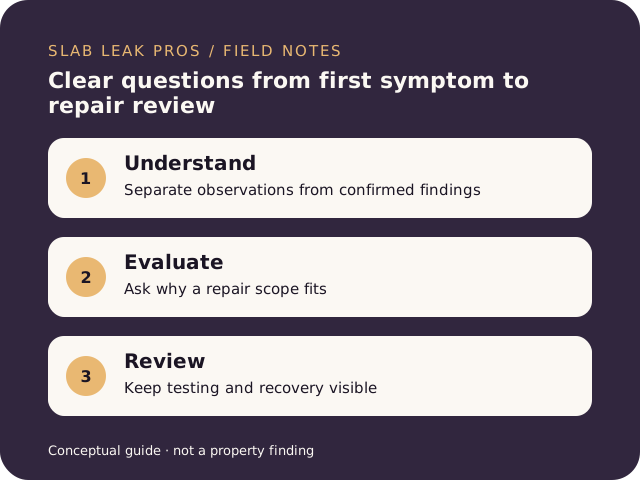
We start with the difference between a sign and a finding. A warm floor is an observation. A confirmed leaking supply branch is a finding. Those are different kinds of information, and a useful repair discussion should explain the steps between them.
Our writing follows that sequence. We explain symptoms, what different checks can establish, how repair options differ, and what belongs in a complete scope. We want a reader to understand why a recommendation fits rather than accept a method because its name sounds reassuring.
We also give building recovery its own place. A stopped leak does not settle every drying, flooring, or structural question. Our guides ask what remains after the pipe work so a homeowner can plan the full path back to normal use of the affected room.
The Slab Leak Pros introduction to informed slab leak decisions in Placentia brings these topics together. It is the starting point for readers who know something has changed but do not yet know which repair question to ask.
What principles shape our guidance?
We favor specific explanations that help a homeowner check the reasoning.
- Evidence before a method. We explain what a symptom can suggest and what it cannot establish.
- A clear repair boundary. We ask which line, fixtures, and surfaces belong to the proposed work.
- Useful uncertainty. We identify missing facts rather than fill them with a confident guess.
- Safe homeowner preparation. We focus on notes, photographs, and accessible observations rather than risky equipment work.
- Complete recovery. We separate pipe repair from drying and finish restoration.
These principles keep technical language tied to a practical decision. A reroute is a new path that bypasses a defined supply line; it is not automatically a whole-home pipe replacement. Explaining that distinction can make a fixture list or estimate much easier to read.
We do not use invented reviews, experience figures, credentials, or response promises to support an explanation. Our diagrams are conceptual guides. They do not show an actual property inspection, a located pipe, or completed work at a homeowner’s address.
Our detection guide reflects this approach by describing what confirmation needs to establish. The aim is a documented source and a sensible next step, not a guarantee that one tool answers every concealed question.
How do our neighborhood guides use local information?
We use verified community context where it changes an access or repair question.
Our coverage is centered on named residential areas within Placentia. The guides include Woodfield, Cinnamon Tree, Granada Park, Placentia Lakes, Old Town Placentia, Atwood, and other researched in-city communities. We do not create nearby-city pages and present them as Placentia neighborhoods.
A community description does not establish the plumbing inside a particular home. We do not infer pipe material, foundation type, or responsibility for a repair from a name, an age, or an ownership label. Address-specific records and the actual system need to resolve those questions.
Our Placentia service-area directory helps readers find the relevant planning context. The ordering is an editorial guide rather than a claim about population, local failure rates, or the number of households needing repairs.
For example, the Woodfield guide discusses access around connected homes and garages. We use that documented setting to suggest questions, while leaving pipe ownership and the building assembly to be checked for the individual property.
Water service also needs an address check. A current utility bill is more useful than assigning a supplier to an entire neighborhood without supporting records. We keep that limitation visible because a wrong assumption can misdirect a shutoff or an access request.
How can you use the site before a repair conversation?
Choose the guide that matches the decision you need to make now.
If you are still sorting symptoms, write a short account of what changed and when. If a leak has been confirmed, compare the proposed repair boundary and access. If work is complete, review testing records and the separate tasks required to dry and restore the room.
We encourage readers to keep questions concrete. Ask which finding supports a location, which fixtures a new line serves, or who completes a floor finish. A precise question is easier to answer and record than a general request to make everything right.
This is currently a demonstration website with an inactive fictional phone number. We do not accept inquiries, schedule appointments, or promise live assistance through that number. Our contact page explains the display and the preparation information a homeowner can gather safely.
We keep our voice focused on the guidance we can actually offer here. Before any future customer contact service is activated, the owner must verify the operating facts and provide an authorized working contact method. Until then, use a real local professional or emergency resource when practical help is needed.
Questions about this guide
Is Slab Leak Pros taking repair bookings through this demonstration?
No. The displayed telephone is a fictional example and does not receive calls. This version presents our researched website guidance and design. It is not a booking channel, an availability statement, or confirmation of a repair appointment.
Do your neighborhood guides diagnose the pipes in my home?
They provide local planning context and questions for an address-specific investigation. They do not establish a home’s pipe material, foundation, meter coverage, or repair responsibility. Those details require the actual records, access, and findings for the property.