
What should an Altura repair investigation establish?
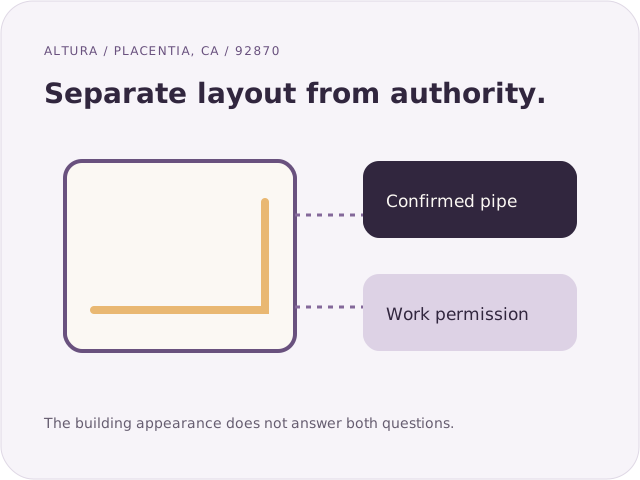
Separate the building's actual wall layout from its ownership description and the route of the failed pipe.
Slab leak repair in Altura, Placentia, CA should start with the individual dwelling and the line serving its fixtures. Available records include attached and detached examples under condominium or association arrangements. That mix makes an ownership label an unreliable shortcut for deciding whether a wall or pipe is shared.
Describe the home as it physically exists: room levels, garage position, adjoining spaces, and the surfaces affected by the symptom. Then identify what the inspection establishes about the active supply or drain. Responsibility and permission questions should be clarified from the relevant documents and authorized contacts, not inferred from appearance.
We connect those Altura-specific questions with the Placentia resource for choosing a slab leak repair. The method should address the confirmed line while making clear which openings, replacement paths, and access permissions belong to the actual property.
Which observations help locate the affected system?
A useful symptom account describes the fixture group and surface change without assigning a shared source in advance.
For dampness close to an adjoining wall, note the first visible edge and any nearby fixture use. Moisture can track from another point inside the same dwelling, so a boundary stain does not prove the neighboring unit is involved. The inspection should identify the route before assigning a shared-pipe explanation.
A warm floor can justify a hot-side question, particularly when paired with unusual water use or fixture changes. Temperature alone cannot establish a buried defect. Record the time and normal use pattern rather than change heater settings or run additional hot water to amplify the clue.
If a drain discharge seems to trigger the symptom, describe the fixture and delay separately from supply-flow evidence. Some water problems occur only during use; others can continue while no fixture appears active. An appropriate test follows that distinction and records any inaccessible section.
Where the meter or shutoff arrangement is unclear, ask the authorized contact how it relates to the unit. A common description such as “condo water” is not a test boundary. The inspector needs to know the measured uses and which controls may be operated safely and with permission.
Which services may fit the Altura inspection result?
The result should explain why the chosen scope fits this line and this building arrangement.
Determining the active branch
Slab leak detection should distinguish a confirmed loss from a surface clue. Ask which system was tested, where the location evidence points, and whether another space or control remains unavailable. Limits belong in the finding before a repair quote assumes complete access.
Renewing a failed supply path
A slab leak reroute may avoid some direct floor work, but its new path needs suitable endpoints and permissions. Identify any exterior or common-area changes. A detached appearance does not establish that every proposed route is within the homeowner's authority to alter.
Addressing a confirmed hot branch
Hot water slab leak repair follows evidence about the heated supply. Ask which fixtures are affected by the work, how service is restored, and what verification is recorded. Compare route and finish details rather than judge the scope by the warmth of the nearest tile.
Repairing a leaking drain section
Under-slab drain repair requires a finding about wastewater piping, not merely an unexplained meter reading. Identify cleanout access and the fixture group involved. A camera can show an accessible interior condition, while additional assessment may be needed to establish containment and repair boundaries.
How should ownership and work authority be clarified?
Use the actual affected component and proposed surface change as the basis for the question.
Ask the inspector to describe the line serving the dwelling before seeking a decision about responsibility. A useful explanation identifies the relevant fixture connections and any evidence of shared service. A plumbing finding can help frame the issue, but it does not replace review of the property documents where responsibility is uncertain.
For a new path, mark the surface or space that would change. An approval request about a defined wall opening or exterior pipe is easier to evaluate than an unspecified permission to fix a leak. Keep the response with the scope and identify any condition that would require a revised route.
Arrange the actual gated entry for the appointment, including an authorized contact if needed. Confirm the applicable covered-plumbing process with Placentia Building and Safety. City review, association direction, and permission to enter another dwelling are separate matters and should not be treated as one blanket authorization.
What should the agreed Altura repair sequence include?
Make the system boundary and surface responsibilities explicit before the work becomes concealed.
- Identify the unit and physical layout. Describe attached surfaces and actual room levels without relying on the legal classification.
- Confirm the failing section. Review the tests, location evidence, and any shared-service uncertainty.
- Map access or a replacement path. Include connection openings and exterior changes, not only the middle of the new line.
- Resolve work authority. Arrange entry, controls, applicable approvals, and the service interruption.
- Verify the repair before closure. Retain relevant test results and inspection records.
- Finish each affected surface. Define moisture assessment, patches, matching, and any outstanding completion task.
If the route changes during work, revisit the permissions and restoration plan before expanding it. A newly exposed condition can justify a revision, but the revised scope should identify what changed and how it affects the homeowner's decision.
Which cost questions prevent a misleading comparison?
Separate pipe replacement from the access and permissions needed to deliver it.
| Diagnostic reach | Which unit, systems, and controls were included in the assessment? |
|---|---|
| Physical access | Which interior or exterior surfaces will be opened or changed? |
| Authority | Who may approve the affected component, common access, or shared interruption? |
| Pipe coverage | Which line becomes new, which section is abandoned, and what remains active? |
| Completion | Who handles verification, required review, drying assessment, and finish restoration? |
A total that includes only pipe installation may leave substantial building work unresolved. Ask what a finished project means for the affected rooms and outside surfaces. Keep any separate trade responsibilities named rather than assume all work sits inside the plumbing price.
What can an Altura homeowner prepare safely?
Bring the physical layout and authorization details together without investigating inaccessible spaces yourself.
- Full service address, unit reference, and confirmed gate entry.
- The actual attached or detached arrangement of the affected surfaces.
- Symptoms listed by room, fixture, and time.
- Known meter and control information, with uncertain shared uses flagged.
- Past repairs or alterations that changed the active branches.
- A current authorized contact for common surfaces or route review.
- The proposed finish-restoration expectations.
Do not open another unit, enter a locked service area, or force a valve to establish ownership through trial and error. For increasing water damage or electrical hazards, keep away and seek prompt appropriate assistance. The displayed demo number does not provide live service.
Which other guides help distinguish layout from responsibility?
Compare the planning question without importing another community's property arrangement.
The Bella Vista on the Green guide also considers detached-home appearance and condominium descriptions. It can help frame a responsibility question while the documents and actual line at Altura remain decisive.
The Cinnamon Tree guide focuses on connected-unit entry and floor-level diagnosis. Use it when planning a question about inaccessible adjoining spaces, without assuming that its building layout describes the Altura dwelling.
Which Altura service guide follows the finding?
The full service set separates the investigated system from the proposed repair method.
- Slab Leak Detection in Altura
- Emergency Slab Leak Repair in Altura
- Hot Water Slab Leak Repair in Altura
- Cold Water Slab Leak Repair in Altura
- Slab Leak Spot Repair in Altura
- Slab Leak Reroute in Altura
- Whole House Repiping in Altura
- Copper Pinhole Leak Repair in Altura
- Under-Slab Drain Leak Repair in Altura
- Main Water Line Repair in Altura
Slab Leak Repair questions in Altura
These answers distinguish legal descriptions, actual pipe connections, and permission for the chosen Altura work route.
Does condominium ownership mean the pipes are shared?
No. The ownership classification does not identify every active connection or component responsibility. Establish the actual line serving the Altura dwelling, then use the relevant documents and authorized contacts to clarify responsibility. The technical source finding and that property question are related but different.
Does a detached-looking home need no association review?
Do not assume that. A proposed change may affect an exterior or common surface even when the dwelling appears detached. Describe the actual work and confirm the current process for that surface before installing a new route.
Can an inspection identify a leak without settling who pays?
Yes. Testing can establish a plumbing finding while cost responsibility remains a separate matter to resolve appropriately. Ask for a clear description of the affected section, route, and served fixtures so the responsibility discussion has useful evidence rather than a generic leak label.
What if the proposed bypass needs an unapproved surface?
Request a suitable revised plan or resolve the required review before that work proceeds. Clarify how the change affects access, testing, price, and finishes. Approval for one route should not be treated as permission for every alternative found during installation.
What should be recorded about an abandoned line?
Keep its location or endpoints, the reason it was taken out of service, and the relationship to the new active path. Identify retained branches. These records help later work avoid confusing old concealed pipe with the supply now serving the fixtures.