
How should a Placentia Lakes leak be identified?
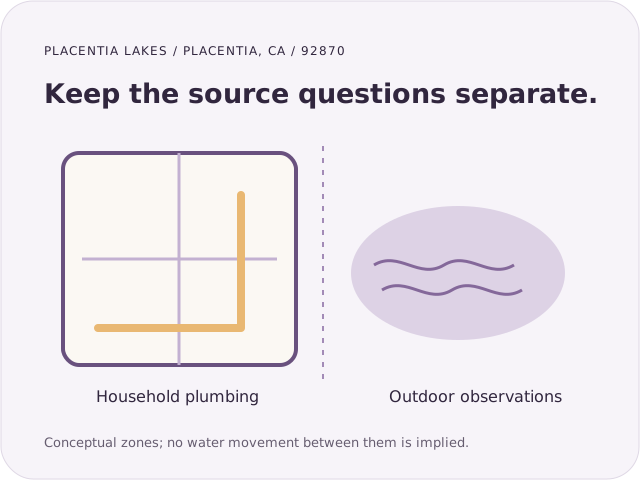
Separate indoor supply or drainage evidence from observations about decorative landscape water.
Slab leak repair in Placentia Lakes, Placentia, CA should begin with the affected unit and its actual water system. The community's attached-home setting and decorative water features create different observations that must not be blended into one assumed cause. A pond or stream near a home does not prove where indoor dampness originates.
Describe what is happening inside: the first wet surface, any warm area, unexplained usage, or symptoms after fixture discharge. Keep outdoor observations on a separate list. This helps the inspection decide whether to test a pressurized household line, a drain, an accessible fixture, or another possible source.
We connect those source questions with the repair decision guide for Placentia slab leaks. For a Placentia Lakes dwelling, the proposal should identify the unit-specific finding and any coordinated access or shutoff needed before a buried pipe repair is selected.
Which problems can look similar around an attached home?
Water appearing at one boundary may have traveled from a different system or level.
A damp ground-floor edge can reflect a buried supply loss, but it can also receive moisture from an appliance, wall connection, or exterior source. Note whether the affected area changes during normal household use or during a quiet period. A timeline is more useful than a conclusion based on proximity to landscape water.
A water meter needs a known relationship to the dwelling. Confirm which uses it records and whether any common arrangement affects interpretation. If another unit or a shared use is included, an apparently quiet household may not be a no-use test for the measured system. Ask who can explain and authorize the required isolation.
Drain-related dampness can appear after a shower, sink use, or laundry discharge. A meter does not directly establish whether the wastewater pipe holds that discharge. Describe any odor or backup, avoid contact with suspect water, and ask for testing suited to drainage rather than an automatic supply-line repair.
A warm floor may add a hot-side clue, while a cold supply loss may produce little temperature contrast. The inspector should explain which findings support the affected line and location. A broad damp or thermal pattern should not be described as a precise pipe route without corroborating evidence.
Which services may fit a Placentia Lakes finding?
Select the method after the system and branch are established, then compare the access it needs.
Confirming the domestic source
Slab leak detection helps distinguish the household branch from other measured uses and narrows the location. Ask which part of the plumbing was tested, whether another unit was involved, and what remains uncertain. The useful result is a defined finding rather than a general label for a damp room.
Correcting unheated supply loss
Cold water slab leak repair addresses a confirmed cold branch. A loss may continue without warmth or visible flowing water in the room. Compare a local opening with a replacement path, including the retained pipe, connection points, and any finishes that must be restored.
Providing a new branch route
A slab leak reroute may bypass the failed under-floor section through suitable spaces. Attached two-story layouts can make endpoint and room-level questions important. Ask what the new line serves and how the old path is taken out of use; do not assume an overhead route exists in every dwelling.
Repairing a leaking waste section
An under-slab drain repair follows drainage-specific findings, which may include an accessible interior inspection and further containment assessment. Clarify cleanout entry and affected fixtures. An obstruction cleared during a prior visit does not itself prove that the damaged waste section has been repaired.
What should be coordinated before testing or repair?
The entry plan should identify the dwelling and any shared access needed for the particular investigation.
Arrange gated entry and identify the actual unit before an appointment. Tell the inspector which rooms are available and whether a service area requires a separate authorized contact. A successful entry arrangement should not depend on someone opening an unrelated gate or dwelling without permission.
Before a shutoff affecting others, establish who may operate the control and how occupants will be informed. Do not test a suspected common line by turning an unfamiliar valve and waiting to see who loses water. The isolation method should be defined by the person responsible for the plumbing assessment.
If the chosen repair changes an exterior or common surface, ask about the current approval process and record the response with the work scope. Confirm city requirements for covered plumbing with Placentia Building and Safety as a separate step. The permission to inspect a unit does not automatically approve every possible replacement route.
What should happen after the source has been confirmed?
Agree on the repair, test evidence, and remaining moisture work before treating the room as finished.
- Review the unit-specific finding. Distinguish domestic supply, drainage, and any exterior-source questions.
- Identify access and service effects. Mark openings or replacement routes and the fixtures that lose use.
- Confirm permissions and responsibilities. Resolve shared controls, exterior review, and the applicable public process.
- Complete the agreed pipe work. Explain any new condition that changes the replacement limits before expanding the job.
- Verify before concealing. Keep the appropriate test and inspection information with the repair record.
- Finish the affected space. Identify drying assessment, cleanup, concrete or wall patching, and final surface work still needed.
The cause of indoor wetness should be addressed before a new floor finish is installed. A pipe repair and the assessment of remaining moisture are related but distinct tasks. Ask who confirms readiness for each restoration stage so responsibility does not disappear between the plumbing and finish trades.
Which cost questions are especially useful here?
Separate the diagnosis, access, shared coordination, and finished-room tasks in the proposal.
| Test boundary | Which unit and measured uses are included, and what access remains unresolved? |
|---|---|
| Repair endpoints | Which branch is repaired or replaced, and which fixtures or sections stay unchanged? |
| Work access | What gate, unit, wall, ceiling, floor, or exterior arrangements are required? |
| Approvals | Who handles any shared-control authorization, association review, and required inspection? |
| Final condition | Who assesses moisture and completes the agreed interior or exterior restoration? |
A quote should not fold an unconfirmed landscape explanation into a household repair charge. Ask which findings justify the actual plumbing work and which observations remain separate. If additional investigation is proposed, it should have a clear purpose and scope.
What information can you gather without changing the evidence?
Prepare a description that lets the inspector compare household activity with the symptom timeline.
- Unit address and the entry arrangement for the booked visit.
- Inside and outside observations recorded as separate notes.
- Which fixtures were recently used and whether water is spreading now.
- Known meter or shutoff details, plus the authorized contact if shared.
- Prior repair records for the same room or branch.
- Photos taken without entering wet or unsafe areas.
- The surfaces expected to be included in restoration.
If active water affects safe access or reaches electrical equipment, leave the affected area and request appropriate urgent assistance. Do not wait to resolve a landscape theory while damage is increasing. The site phone shown in this preview is a fictional number and cannot receive a response request.
Which other Placentia area guides help with attached-home questions?
Compare the service-planning issue while retaining the facts of this unit.
The Cinnamon Tree guide focuses on floor level and connected-unit testing. It can help prepare questions about water coming from above, without establishing the same branch arrangement at Placentia Lakes.
The Mariposa Lane guide considers gate entry, garage-related routing, and property responsibilities. Use those topics to improve an access conversation rather than assume one association's process applies to another community.
Which Placentia Lakes service guide fits the evidence?
The complete set separates diagnosis, supply repairs, drainage, and incoming-line work.
- Slab Leak Detection in Placentia Lakes
- Emergency Slab Leak Repair in Placentia Lakes
- Hot Water Slab Leak Repair in Placentia Lakes
- Cold Water Slab Leak Repair in Placentia Lakes
- Slab Leak Spot Repair in Placentia Lakes
- Slab Leak Reroute in Placentia Lakes
- Whole House Repiping in Placentia Lakes
- Copper Pinhole Leak Repair in Placentia Lakes
- Under-Slab Drain Leak Repair in Placentia Lakes
- Main Water Line Repair in Placentia Lakes
Slab Leak Repair questions in Placentia Lakes
These answers address decorative-water assumptions, measured supply boundaries, and completion questions for the affected Placentia Lakes unit.
Does living near decorative water explain indoor dampness?
Not by itself. At Placentia Lakes, outdoor water features and household plumbing need to be treated as separate observations until evidence connects them. The inspection should identify the source affecting the room rather than assume either a landscape cause or a buried supply defect.
Can I use my unit's quiet period as a meter leak test?
Only if the measured supply and included uses are understood. A shared or otherwise broader meter arrangement can include activity outside your dwelling. Ask for the relevant boundary before interpreting the reading. Do not operate unfamiliar common controls to create a test.
Does an attached two-story layout rule out a slab leak?
No. It changes the questions about the affected level and pipe route. A ground-level supply or drain section may still be involved, while an upstairs symptom needs other source checks. The finding should follow the actual building rather than a blanket assumption.
Who should approve a new pipe path through an exterior area?
Identify the current authority for the particular surface and the applicable plumbing approvals. The required process depends on the route and property arrangement. Keep any response with the proposal so the chosen path is not installed before necessary review is resolved.
What if plumbing is repaired but the floor remains damp?
Ask for the repair test result and a separate assessment of remaining moisture or another source. Do not conceal the area simply because active supply loss stopped. The handover should name who manages drying and restoration, and what finding would justify further investigation.