
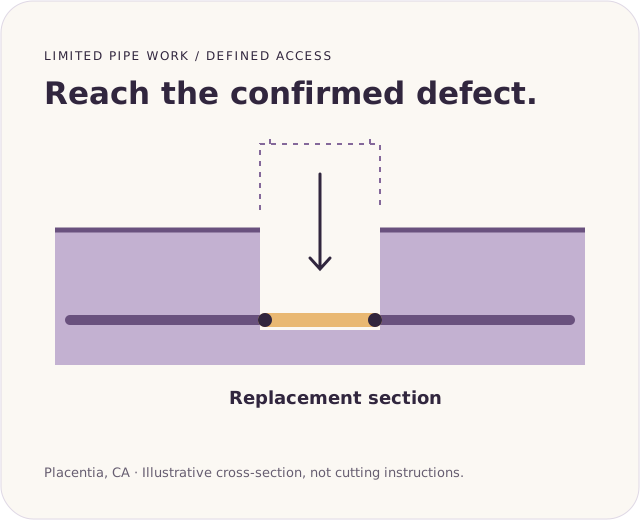
What is a slab leak spot repair?
This method reaches one confirmed failure and replaces a limited section of pipe through planned access.
Slab leak spot repair in Placentia, CA is direct access to a localized pipe defect beneath the concrete floor. The failed piece is removed and a suitable replacement is installed. Most of the existing line remains in use. That limited scope can be useful when the problem is isolated and the retained pipe is worth keeping.
The word “spot” describes the pipe-repair scope, not necessarily the size of all the work. Flooring must be protected or removed, concrete access must be planned, and the opening must later be restored. A small damaged section beneath a cabinet can be harder to reach than a longer section in an open room.
We help you look at both the plumbing and the access. The homeowner's Placentia slab repair guide compares this approach with other methods. For spot work, the central question is whether a defined opening gives a sound repair without leaving an unsuitable section active beside it.
When is direct access a reasonable option?
A local opening makes sense only when its location and the surrounding pipe support it.
The failure can be located with useful confidence
The contractor should explain how the marked location relates to the affected line. A moisture stain is not enough by itself because water can travel under finishes. Ask what leak-location testing established and whether a larger uncertainty area could change the proposed opening. Access should answer a specific repair need.
The retained line has a defensible role
A single damaged joint and a branch with several prior failures are different situations. Discuss the visible pipe condition, repair history, and what cannot yet be assessed. The proposal should explain why replacing only the local section is suitable. It should also identify what happens if the surrounding pipe is worse than expected once exposed.
The complete access cost is acceptable
Compare the combined effect of removing flooring, opening the slab, repairing the line, patching concrete, and matching finishes. A route beneath valuable tile may change the preferred choice even when the defect is small. A localized repair should not be chosen from the plumbing labor price while all room-restoration costs remain unpriced.
Which signs and findings belong in the repair discussion?
Some observations support targeted work; others are reasons to compare a different scope.
A specific buried section is confirmed leaking
A test finding tied to a well-marked section is the strongest starting point. Ask for a record that connects the affected branch to that location.
The same room has a repeat wet patch
Repeat appearance can help focus investigation, but the visible patch may not sit over the pipe defect. Location evidence still matters.
One branch loses pressure during isolation
A defined test result narrows scope. It does not by itself establish whether one short replacement or a longer route is the better repair.
A previous local repair has failed nearby
That history may favor wider replacement rather than another opening. Identify whether the new problem is at the old connection or elsewhere on the retained line.
A known joint or transition is suspect
Different materials or a prior alteration may explain why one point needs attention. Ask whether the suspected defect is observed or inferred.
A floor finish must be disturbed to reach the pipe
Access may be feasible but expensive to restore. Gather information about replacement material before approving removal of a difficult-to-match surface.
The route is obstructed by built-in furniture
A cabinet, island, or permanent fixture can expand work beyond concrete cutting. Identify these obstacles before treating the opening as a simple task.
Several separate failures are documented
Multiple defects make the limits of a spot solution important. Ask whether local repair addresses the actual pattern or only the latest visible symptom.
What can cause damage at a single point?
Finding one failure does not establish that every nearby pipe is sound or that every pipe is failing.
A local defect may involve a joint, a damaged pipe wall, or a previously altered section. The surrounding material should be assessed when access permits. A cause stated before exposure may remain provisional. Ask for photographs of what was removed and a description of the condition that justified the final replacement limits.
For copper, a small perforation can be associated with localized corrosion. The appearance of the failed piece and the wider system history matter. A plumber should not attribute every pinhole to one citywide water characteristic without relevant evidence. Nor does a visible hole establish the condition of pipe that remains concealed elsewhere.
Damage introduced during earlier construction is another possibility to investigate when the location fits known alterations. Old invoices and remodel plans can help locate transitions and abandoned lines. The repair should connect to suitable material rather than continue through a section that cannot support the selected joint or fitting method.
If the exposed pipe changes the repair recommendation, pause for a defined explanation. Ask what was found, how much more work is proposed, and why the original spot scope no longer fits. A documented change is easier to assess than a request to approve an open-ended expansion while the floor is open.
What must be considered before a slab opening?
The pipe location and the slab's embedded hazards are separate access questions.
A concrete floor may contain reinforcement, stressed tendons, electrical services, or other embedded components. A post-tension system uses steel under tension; careless cutting can be dangerous. Do not infer the construction from an age estimate or a nearby home's floor. Ask how the proposed opening will be evaluated before demolition begins.
The Post-Tensioning Institute's work on existing structures explains why tendon location and planned modification matter. The homeowner's role is to request an appropriate access plan, not to perform scanning or decide a safe cutting depth. Specialized evaluation may be needed for the actual construction.
Plan dust control and the work boundary with the contractor. Identify rooms that can remain occupied, access routes, and protection for furnishings. Do not lift flooring or start breaking the slab to reduce the quoted work. That can damage the line, disturb hidden hazards, and remove evidence the inspection needs.
What can you safely arrange before direct access?
Preparation should make the work area accessible while preserving the contractor's defined opening plan.
Ask for the intended access location to be marked and photographed before moving furniture around it. Move light household items only when the area is dry and safe. Discuss heavy furniture, appliances, and permanent cabinets separately. Know whether the agreed price includes moving and replacing them or whether another arrangement is needed.
Look for spare floor material and record its product details if available. A spare tile or plank can help plan matching, but it does not guarantee a seamless repair. Ask how much material may need removal and whether the surrounding finish can be lifted without additional damage. Agree on that uncertainty before opening the floor.
Prepare the water-use plan for occupants and pets. Note which facilities may be unavailable and whether another safe bathroom is usable. Keep doors and building access clear without blocking designated routes. If an association must approve a shared-area activity, obtain the relevant direction rather than assuming an interior pipe repair affects no common property.
What should the direct-access visit include?
The repair remains inspectable until the relevant tests and approvals are complete.
- Confirm the final marked area. Connect the inspection findings with the planned opening and review the agreed work boundary.
- Assess embedded components. Establish the controls or specialist input appropriate for the slab and any nearby services.
- Expose and inspect the failure. Document the actual defect and the condition of the pipe selected for reconnection.
- Replace the agreed section. Use an appropriate material and joining approach for the conditions and permitted scope.
- Test and obtain required review. Keep the work accessible until the applicable testing and inspection steps are satisfied.
- Restore in the correct sequence. Coordinate moisture assessment, concrete patching, and finish installation so the floor is not closed over unresolved conditions.
Ask who confirms the opening is ready for each next trade. Plumbing completion, concrete readiness, and flooring installation are different milestones. Keep the final pipe photos and any inspection documentation before those details become concealed again.
What drives the cost of a spot repair?
Ask for the complete access-to-restoration scope alongside the pipe replacement.
| Location confidence | Further tracing or a revised opening area can change the work before repair begins. |
|---|---|
| Slab and embedded hazards | Construction assessment and any specialized access requirements need a defined responsibility. |
| Obstructions and finishes | Cabinetry, fixtures, flooring, and furniture can add removal or restoration tasks. |
| Condition at exposure | Unsuitable surrounding pipe may require a justified change to the replacement length or method. |
| Closing the opening | Testing, permits, concrete, drying, and finish matching should be priced or explicitly excluded. |
Confirm covered-work requirements with Placentia Building and Safety. A small opening is not itself a permit exemption. The proposal should state who handles required applications and inspections.
When should you consider another route instead?
A repair choice should minimize the total reasonable burden, not simply the amount of new pipe.
When direct access crosses a hard-to-restore surface, ask how a bypass route around the failed section would compare. It may shift disruption to walls or ceilings. Request both complete restoration scopes so the alternative is assessed fairly. Neither method is automatically right for every slab leak.
In Granada Park, plan gated entry and the work location before equipment arrives. A homeowner should clarify any association involvement without assuming it pays for the line. The repair location and ownership documents govern that question.
For Corte Vista Villas, describe compact staging and the available route into the room. Equipment access can affect floor protection and work sequencing. A property label does not establish whether a wall is shared or whether an exterior bypass needs approval.
If the supply is actively flooding the room, control and safety come before choosing the final spot opening. Keep away from water near electricity and seek urgent help when safe access is threatened. Do not start emergency demolition yourself. Temporary control can allow the permanent access choice to be made with better information.
What should you clarify before a spot repair?
Make the access limits, retained piping and restoration obligations understandable.
Does spot repair mean only one tile will be removed?
No. The access area must allow safe work on the actual pipe, and finishes may need removal beyond the defect. Ask for the proposed opening boundaries and restoration allowance. The word spot describes the limited pipe scope, not a guaranteed number of tiles.
Can a spot repair guarantee the rest of the old line will not leak?
No local replacement can establish the future condition of every concealed section. Discuss what was seen, the prior failure history, and any limits on the assessment. If a warranty is offered, read its actual scope instead of assuming it covers all retained plumbing.
Should the floor be patched before the pipe test is complete?
The appropriate tests and any required inspection should be resolved while access is available. Ask for that sequence in the proposal. Closing too early can make later review or correction more disruptive. The actual closure requirements depend on the work and local approval process.
Who replaces the finished floor after pipe work?
That responsibility needs to be named in the agreement. The plumbing scope may stop at a concrete patch or may include further restoration. Clarify matching, material supply, drying readiness, scheduling, and payment so the completed pipe repair has a defined path to a usable room.
What if the leak is not where the opening was planned?
Ask what the new finding shows before approving an enlarged or different opening. Further location work may be preferable to widening access on speculation. Keep the original marked evidence and document why the scope changes. A new area should have a specific purpose.
Is direct access suitable for every slab construction?
No. Embedded components and structural conditions can constrain an opening. The proposed area needs an appropriate evaluation, and specialist input may be required. A different pipe route may be worth comparing when safe access would create disproportionate work or risk.
Where can you explore local spot-repair planning?
Use the relevant community guide to prepare property-specific access questions.
- Slab Leak Spot Repair in Woodfield
- Slab Leak Spot Repair in Cinnamon Tree
- Slab Leak Spot Repair in Granada Park
- Slab Leak Spot Repair in Placentia Village Groves
- Slab Leak Spot Repair in Placentia Lakes
- Slab Leak Spot Repair in Corte Vista Villas
- Slab Leak Spot Repair in Northpoint at Alta Vista
- Slab Leak Spot Repair in Old Town Placentia
- Slab Leak Spot Repair in Atwood
- Slab Leak Spot Repair in La Jolla
- Slab Leak Spot Repair in Altura
- Slab Leak Spot Repair in Bella Vista on the Green
- Slab Leak Spot Repair in Alta Vista South
- Slab Leak Spot Repair in Hamptons on the Green
- Slab Leak Spot Repair in Mariposa Lane