
What makes a suspected slab leak an emergency?
An active water problem needs attention when it threatens safe access, continues spreading, or cannot be controlled.
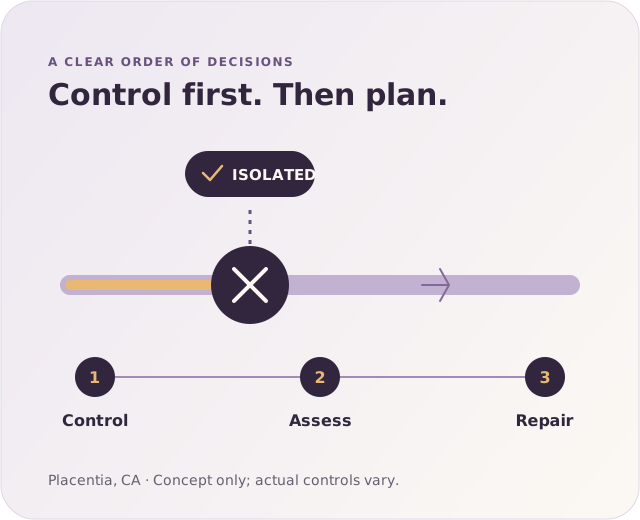
Emergency slab leak repair in Placentia, CA starts with assessing immediate hazards and limiting ongoing water loss where that can be done safely. A permanent repair follows once the leaking system, access needs, and suitable method are understood. The first decision is what must happen now; the second is what work will resolve the cause.
You do not need proof of a buried pipe failure before seeking urgent assistance. Explain the conditions you can see: a growing wet area, water entering another room, or a supply you cannot safely shut off. A stain alone does not locate the source, and an urgent response should still distinguish plumbing from other causes.
We organize this guide around those first decisions. For the complete comparison of repair approaches, return to our slab leak repair options for Placentia homes. Here, the focus is the period between discovering active water and agreeing on a safe, documented next step.
What should you do while arranging help?
Put distance between people and hazards before trying to protect finishes or belongings.
- Keep the affected area clear. Move people and pets to a dry, safe place. Do not investigate an unstable surface or enter water to find the source.
- Consider a known household shutoff. Use it only if you know what it controls, are authorized to operate it, and can reach it safely. Stop if the valve is unfamiliar, stuck, or in a hazardous area.
- Report the current conditions. Say whether water is still entering, which rooms are affected, and whether any equipment or shared spaces are involved. Confirm that the service you reach can address the situation.
- Record what is safe to record. A photo from the doorway and a note of the discovery time can help. Documentation must not delay leaving a dangerous area.
The CDC's electrical safety guidance warns against operating power or electric tools while standing in water. The same precaution matters around an indoor plumbing release. Do not improvise an electrical shutoff procedure from a plumbing checklist.
How does urgent control differ from permanent repair?
Stopping the immediate release creates room for diagnosis. It does not establish that the failed pipe has been repaired.
Control the ongoing release
An authorized person may be able to isolate the affected supply, depending on the valve arrangement. If a branch cannot be separated, a wider water interruption may be necessary. Ask what remains usable and what must stay off. Temporary control should have clear limits and instructions, including whom to contact if water starts spreading again.
Identify the actual system
A pressurized supply leak behaves differently from a drain leak that appears during fixture use. Moisture from an appliance or wall can also reach the floor. Once immediate conditions permit, slab leak detection can help establish which line is involved and narrow the source. A rushed opening based only on surface damage can create additional work.
Choose and authorize the lasting work
The permanent proposal may involve a localized pipe repair, a replacement route for a failed branch, or a broader plan supported by the pipe condition. Ask what evidence supports the choice and where access is required. Urgency does not remove the need to explain the price, exclusions, finish repairs, or any further authorization needed.
Before water is restored, the completed work needs appropriate testing. Ask whether restoring one section also puts another suspect section back under pressure. Keep the control plan and the permanent repair record separate so a temporary shutoff is never mistaken for a completed repair.
Which eight conditions call for prompt attention?
These conditions help communicate urgency. They do not all prove that a slab pipe is the cause.
Water advances into another room
A changing boundary suggests the release or spread is continuing. Report the rate of visible change without entering the wet area to measure it.
The household supply cannot be controlled
A valve that is stuck, unknown, or unsafe to reach changes the response needed. Do not force it or assume a utility valve is yours to operate.
Water reaches an appliance or outlet area
Treat possible electrical involvement as a safety concern. Keep away and explain the location when seeking assistance; do not test whether the equipment still works.
The only safe route becomes wet
A hallway or doorway affected by water can limit access. Move to a safe place before the route becomes harder to use.
Water affects another dwelling
In a connected building, a release can involve more than one occupant. Notify building management and describe the affected units without assuming pipe ownership.
A hot-water symptom is spreading
Increasing warmth with active wetness deserves prompt assessment. Avoid touching exposed water or changing water-heater controls on speculation.
Flooring or a ceiling becomes unstable
A soft surface, sag, or sudden change needs distance and assessment. Keep people out from beneath damaged ceilings and away from surfaces that may fail.
Water may contain sewage
Odor, backups, or water following drain discharge can require a different cleanup response. Avoid contact and do not spread it into other rooms.
Why can a hidden leak become urgent?
The consequences depend on where escaping water goes and whether the supply remains active.
A buried water line can continue releasing water while the household supply is pressurized. The first visible patch may appear after water has already traveled beneath flooring. A small opening in a pipe can therefore create a much larger area to assess. The shape of that area does not reliably show the location of the pipe defect.
Different failures can lead to the same urgent symptom. A connection can separate, a damaged section can open, or a previously weak point can worsen. The cause may remain uncertain until the line is tested or exposed. Avoid accepting a neighborhood-wide explanation for a problem that has not yet been examined at the property.
Some situations involve several sources. A supply leak can occur near an appliance leak, or water from a wall can appear beside an old floor stain. Describe new changes separately from older damage. That distinction helps the inspection focus on what is active rather than treating every mark as part of one event.
If warmth or unusual hot-water demand accompanies the release, the later repair discussion may include hot water slab leak repair. A warm floor still needs supporting evidence. Do not keep the water running merely to preserve a temperature clue when damage is increasing.
Which checks can wait, and which facts help now?
An emergency is not the time to run experiments that add water or delay control.
Skip a prolonged meter comparison when water is visibly spreading. Do not run showers, flush toilets, or start laundry to see whether the wet area grows. Once the immediate release is controlled, the inspection can use a planned test rather than repeated household use.
From a safe position, note when the symptom began and the last normal use of the nearby fixtures. Record whether water appeared to slow after an authorized shutoff. If a meter or valve is in a common area, leave interpretation and operation to the person responsible for it.
Collect the service address, unit number, entry instructions, and a reachable contact. Explain mobility or access needs that could affect a water interruption. Keep older repair invoices nearby if they are easy to find, but do not return to a hazardous room for paperwork.
What should an urgent assessment cover?
Confirm who is coming, what the visit covers, and what decisions may be needed on arrival.
- Review immediate hazards. Identify areas that must stay clear and any need for electrical or contamination assessment beyond plumbing.
- Confirm the water-control status. Establish which supply is off, who authorized it, and whether another household or system is affected.
- Inspect the active evidence. Separate current water entry from residual dampness. Ask how the affected supply or drain will be distinguished from other sources.
- Agree on any diagnostic access. Clarify the purpose and extent of an opening before authorizing it. Concealed slab construction and embedded services need consideration before cutting.
- Set the repair scope. Record the method, price, water interruption, permit responsibilities, and restoration exclusions. Additional findings should trigger an explained change, not an undefined expansion.
- Document testing and handover. Confirm what was repaired, what remains temporary, and what drying or finish work comes next.
A first visit may stabilize the situation and leave permanent work for a later stage. Ask why, what precautions apply during the gap, and how the next step will be arranged. Actual scheduling depends on the conditions and availability confirmed directly; this website makes no arrival-time promise.
What affects emergency slab leak repair cost?
Separate urgent attendance, diagnosis, permanent plumbing, and recovery work when reviewing a proposal.
| Attendance and availability | Ask about any urgent or out-of-hours charge and whether it covers assessment, work, or both. |
|---|---|
| Water-control difficulty | Shared supplies, inaccessible valves, or damaged controls can require additional coordination before testing. |
| Access and pipe work | Location, required openings, surrounding pipe condition, and the selected repair method affect the job. |
| Safety and recovery needs | Electrical evaluation, contaminated-water cleanup, drying, and damaged-material removal may need separate scopes. |
| Approvals and restoration | Confirm any permit, inspection, concrete, drywall, paint, and flooring responsibilities before assuming the room will be fully restored. |
Ask Placentia Building and Safety to confirm requirements for the covered repair scope. Do not assume urgency creates a permit exemption. Keep receipts and written findings so any later discussion about completed work starts from a clear record.
What matters in Placentia communities with shared access?
A correct address and an authorized contact can prevent confusion during an urgent response.
In Placentia Lakes, arrange gated entry and identify the affected unit before an appointment. Explain whether the water appears inside the home or near landscape features. The presence of decorative water does not establish the source of indoor dampness, and a shared shutoff needs coordination.
For Mariposa Lane, provide the entry instructions and ask which association contact can clarify common-area access. A detached appearance does not answer every responsibility question. Identify the actual line and affected property before deciding whose approval is needed.
After the supply problem is addressed, ask how the wet area will be assessed. The EPA's moisture guidance calls for drying water-damaged areas and items within 24–48 hours to help prevent mold growth. Appropriate cleanup depends on the source and materials; do not use a fan to spread suspect contamination through the home.
What questions help during an urgent repair discussion?
Keep the answers focused on the actual conditions, service availability, and agreed scope.
Is a high bill alone an emergency?
An unexplained bill deserves investigation, but urgency depends on current conditions. A bill with no visible water or immediate hazard may allow a planned diagnostic appointment. Growing wetness, uncontrolled flow, electrical involvement, or loss of safe access calls for a more urgent response.
Should I shut off water to the whole building?
Do not operate a building-wide control without authorization. Contact management or the person responsible for the shared system and report what is happening. A shutoff can affect other occupants and equipment. Use only a familiar household control that you can safely reach and are permitted to operate.
Can a temporary shutoff be enough for the first visit?
It may control immediate loss while diagnosis or permanent work is arranged. Ask which section is isolated, what must remain off, and what would require another urgent call. A controlled supply is a temporary condition until the failed line and its repair are resolved.
Do I need to know where the pipe is before seeking help?
No. Describe the visible conditions and any safe water-control action already taken. The inspection should determine the affected system and suitable access. Do not drill, remove flooring, or cut concrete to supply a location for the call. A guessed location can misdirect the work.
Will the first repair price include drying and flooring?
Only when those items are expressly included. Ask for a breakdown of plumbing, access, water removal, drying assessment, and finish work. Establish who coordinates separate work and how completion is confirmed. A successful pipe repair can still leave wet materials or restoration tasks outstanding.
Can I turn the water back on to see if the leak stopped?
Follow the handover instructions for the actual repair or isolation. Reopening a supply that was shut to control a known problem can restart the release. Ask who will restore service, what testing is needed first, and which fixtures should remain unused until the system is cleared.
Which Placentia area guide is relevant?
These guides organize access and repair-planning questions by community. Availability must be confirmed for the actual service address.
- Emergency slab leak repair in Woodfield
- Emergency slab leak repair in Cinnamon Tree
- Emergency slab leak repair in Granada Park
- Emergency slab leak repair in Placentia Village Groves
- Emergency slab leak repair in Placentia Lakes
- Emergency slab leak repair in Corte Vista Villas
- Emergency slab leak repair in Northpoint at Alta Vista
- Emergency slab leak repair in Old Town Placentia
- Emergency slab leak repair in Atwood
- Emergency slab leak repair in La Jolla
- Emergency slab leak repair in Altura
- Emergency slab leak repair in Bella Vista on the Green
- Emergency slab leak repair in Alta Vista South
- Emergency slab leak repair in Hamptons on the Green
- Emergency slab leak repair in Mariposa Lane