
Where should a Cinnamon Tree leak investigation begin?
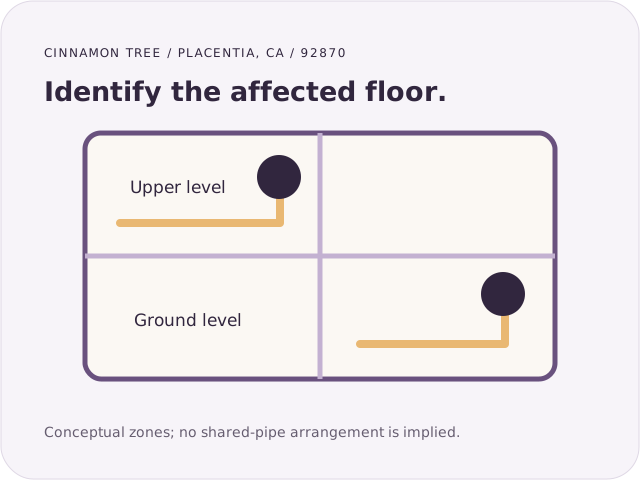
The unit number and floor level help prevent an upstairs symptom from being mistaken for a buried slab failure.
Slab leak repair in Cinnamon Tree, Placentia, CA needs to start with the affected condominium, its fixtures, and the source of the water. The community has documented two-story condominium buildings. Water on an upper floor, in a wall, or at a ceiling calls for source checks that account for that arrangement before a below-slab repair is proposed.
Describe the first room affected and the direction in which dampness has changed. If another unit appears involved, provide that observation without assigning blame. A shared building can contain private and common piping, and the relevant property documents and actual route must clarify responsibility. The visible wet spot alone cannot do that.
We make this guide specific to those unit-access decisions. The Placentia repair choices explained for homeowners provide the broader method comparison. At Cinnamon Tree, an appropriate repair scope should also identify the authorized entry, water interruption, and communication needed around connected dwellings.
Which symptoms need different explanations in a condominium?
A useful description distinguishes active supply loss, discharge-related moisture, and water arriving from another level.
If water appears below a bathroom or near a common wall, record which fixtures were used beforehand. A shower connection, waste route, supply pipe, or surface-water problem can produce different findings in nearby places. Do not repeatedly run the suspected fixture to demonstrate spreading moisture. The inspection should choose a controlled test for the actual question.
Meter observations need a known service boundary. A reading associated with several uses cannot be assigned to one unit by subtraction based on a guess. Ask management or the appropriate responsible party how the meter and valves relate to the affected dwelling. Testing that interrupts more than one occupant needs clear authorization and communication.
A warm area may suggest a hot-side investigation, while a cool damp surface may offer little temperature evidence at all. Either symptom still needs plumbing and moisture findings. A thermal image does not establish the ownership or exact depth of the failing line. Keep the diagnostic result separate from the question of who may authorize its repair.
Odor or water after drain use deserves a wastewater-focused assessment. Avoid the affected space if the water may be contaminated. A cleared blockage is useful information, but it does not automatically show that the pipe contains water correctly afterward. Ask for the explanation tied to the particular tested section.
Which repair services should a Cinnamon Tree homeowner compare?
Choose the service by the findings rather than by a generic label attached to floor damage.
Establishing the source
Slab leak detection should identify the affected system and location evidence. In a condominium investigation, ask which accessible points were used and whether any section remained untested because entry or a shared control was unavailable. Those limits belong in the result.
Controlling an active release
Emergency slab leak repair planning prioritizes safety and water control before permanent work. If another dwelling may be affected, notify the authorized building contact promptly. Do not use an unfamiliar shared shutoff or enter water near electrical equipment in an attempt to speed the process.
Resolving a confirmed hot-water loss
A hot-water repair can target the failed section or replace its route, depending on access and condition. Discuss which fixtures lose hot service and whether a wall or ceiling opening is part of the proposed method. Warmth does not justify cutting into the nearest floor without location support.
Repairing the drain route
Under-slab drain leak repair is relevant when appropriate investigation identifies wastewater piping below the building. Floor level, cleanout access, and connected fixtures shape the scope. A drain repair is not interchangeable with replacing a pressurized supply branch.
What should the repair plan say about other occupants?
A precise unit-level scope makes it easier to arrange the necessary permissions and interruptions.
- Identify the symptom and level. Use the full unit reference and distinguish floor, ceiling, and wall observations.
- Confirm the relevant supply or waste route. Explain the test boundary and any entry still required.
- Resolve authority for access. Establish who can permit entry, operate shared controls, or approve affected common surfaces.
- Define the permanent work. Mark the opening or replacement path and assign restoration tasks.
- Complete the appropriate tests and review. Keep the necessary work accessible until those steps are satisfied.
- Hand over the result. Record what was repaired and any remaining drying, cleanup, or finish work.
For covered residential plumbing, confirm the applicable city requirements with Placentia Building and Safety. Building-management approval and city review are different processes. Ask who coordinates each without assuming that a diagnosis already authorizes every later change.
What details make a Cinnamon Tree visit more useful?
Prepare the entry and symptom facts without opening fixtures or testing common equipment yourself.
- Unit number, floor level, and safe gated-entry arrangements.
- Which fixtures were used before moisture appeared.
- Whether the source is active now or only residual dampness is visible.
- Names of authorized contacts for connected-unit entry or shared controls.
- Earlier plumbing or drain-service records for the same location.
- Any safe photographs showing the first affected surface and later spread.
- The utility and meter information actually available for the dwelling.
Leave locked service areas and cleanout caps to the responsible person. Do not shift water into another unit by improvising a temporary drain or opening a backed-up line. For immediate hazards, move away and seek appropriate help. The demonstration number in this package cannot receive an urgent service request.
Which other community guides help compare access questions?
Use the differences in building arrangement to improve the questions, not to copy a repair design.
The Placentia Lakes guide discusses attached-home testing and distinguishing household water from landscaped-water observations. A connection found there should not be assumed to describe Cinnamon Tree, but the distinction between measured uses remains a useful planning question.
The Woodfield repair guide covers townhome room levels and garage-related access. Compare it when discussing a replacement route, while keeping condominium entry and shared-control issues specific to the dwelling being assessed.
Which Cinnamon Tree service guide fits the finding?
After the system is identified, the relevant guide can help you compare its testing and repair scope.
- Slab Leak Detection in Cinnamon Tree
- Emergency Slab Leak Repair in Cinnamon Tree
- Hot Water Slab Leak Repair in Cinnamon Tree
- Cold Water Slab Leak Repair in Cinnamon Tree
- Slab Leak Spot Repair in Cinnamon Tree
- Slab Leak Reroute in Cinnamon Tree
- Whole House Repiping in Cinnamon Tree
- Copper Pinhole Leak Repair in Cinnamon Tree
- Under-Slab Drain Leak Repair in Cinnamon Tree
- Main Water Line Repair in Cinnamon Tree
Slab Leak Repair questions in Cinnamon Tree
These questions focus on floor level, authorized controls, and how the completed work is documented for a Cinnamon Tree condominium.
Does dampness upstairs mean the pipe is under the slab?
No. An upstairs symptom can involve fixtures, wall piping, drainage, or water from another source. At Cinnamon Tree, identify the actual level and fixture pattern first. The assessment should explain how the evidence relates to the building rather than assign every wet floor to a below-slab line.
Can testing go ahead without entry to another unit?
Some questions may be answered from the accessible dwelling, while others may remain limited. Ask what can be established and what requires additional access. Coordinate that entry through authorized contacts; a partial result should not be described as a complete assessment of inaccessible piping.
Who decides whether a shared shutoff may be used?
Confirm the responsible party for the actual building control. Tell that contact which dwelling is affected and what the proposed test or repair requires. Do not assume permission follows from owning the unit, and do not operate an unfamiliar control to see whose water stops.
Can one quote cover plumbing and damage in two dwellings?
It can only cover what is explicitly agreed and authorized. Identify each area, access permission, cleanup task, and restoration responsibility. Keep the plumbing finding distinct from any allocation of costs or damage responsibility, which needs the relevant documents and appropriate review.
What should I receive after a Cinnamon Tree repair?
Ask for the affected system, unit reference, replaced section or route, and relevant test or inspection records. Include what remains unfinished in any dwelling affected by the agreed work. A clear handover makes later access and moisture questions easier to resolve.