
When is slab leak detection useful in Cinnamon Tree?
First establish whether the moisture involves a ground-level buried supply, a fixture, or piping serving another floor.
Slab leak detection in Cinnamon Tree, Placentia, CA is a process for confirming and tracing a suspected hidden water loss. It should start with the affected unit and system. Moisture on an upper floor is not evidence that the ground-floor slab contains a leaking pipe.
Cinnamon Tree's two-story condominium setting makes vertical relationships important. A ceiling stain below a bathroom, a damp upper-floor finish, and water along a ground-floor wall call for different starting checks. Describe where the water first appeared rather than asking for a slab opening based on the final wet area.
Concealed pressurized piping can be assessed through suitable isolation and location methods. Drain or fixture testing may be needed when the pattern follows use instead of a continuous supply loss. The purpose is to reduce uncertainty before selecting repair access, including access outside the reporting unit where justified.
We explain the general tools in our slab leak detection service guide. In Cinnamon Tree, the first practical question is what the test includes: one dwelling, an identified branch, or a wider building connection. A result without that boundary can be misread.
Which observations help separate a slab concern from an upstairs leak?
A simple account of floors, fixtures, and timing gives testing a more useful direction.
Note whether dampness changes after a shower, sink discharge, laundry cycle, or ordinary hot-water use. Do not repeatedly run an appliance to recreate damage. A clear earlier observation is more useful than making the area wet again while access remains unresolved.
If the sound of running water continues while your fixtures are unused, report which other uses or units may still be served by the observed controls. A reading from a common meter cannot be treated as a no-use result for one condo unless those other demands are understood.
A warm ground-floor patch can support a hot-side investigation, but heating and recent fixture use may affect the surface. A thermal image measures temperature differences at the surface. It cannot prove the depth of a failed line or show the interior of concrete.
- Ceiling stain below another room: record the room above and the sequence of visible wetting.
- Ground-floor edge dampness: identify nearby plumbing and any outdoor source that also needs review.
- Unexplained account use: bring the bill and clarify which occupancy it serves.
- Repeated moisture after cleanup: preserve dates and photos, with electrical hazards kept clear.
How should a Cinnamon Tree detection visit be arranged?
Authorized entry and shutoff coordination let the inspector test the intended system safely.
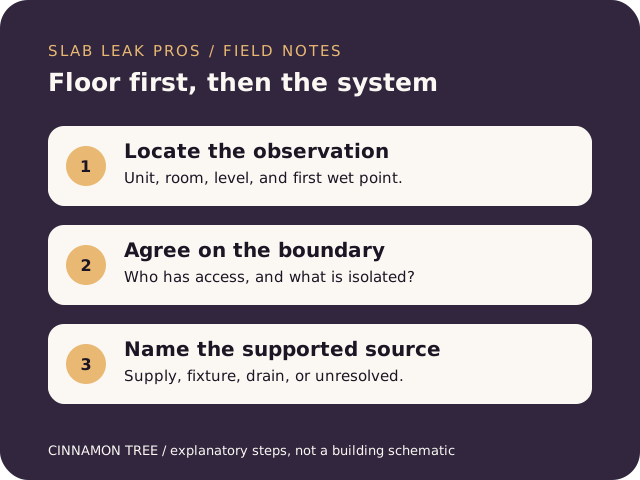
- Locate the affected spaces. Identify the building, unit, level, and first wet point.
- Arrange gated entry. Confirm a reachable contact and any needed access beyond your own rooms.
- Identify the controls. Establish who may operate a valve and who could lose service.
- Choose tests for the suspected source. Compare supply isolation with fixture or drain assessment where the symptoms require it.
- Review the evidence together. Ask which conclusion is supported and what remains outside the inspection.
Avoid adjusting an unfamiliar common valve to prepare a quiet test. It may affect other occupants or fail to isolate the intended branch. Bring the responsible contact into the plan when testing needs a shared enclosure or another unit. Permission to enter one condo does not create permission to inspect every connected space.
For pressurized lines, acoustic listening can help narrow a suspected loss after the relevant system has been identified. Surrounding noise and building paths can complicate the sound. Ask why the chosen mark fits the isolation result, rather than rely on the loudest point alone.
What affects the price and any repair approval?
The scope should explain how testing proceeds when another level or controlled space is unavailable.
| Occupied spaces | Are the affected unit, level, and necessary adjoining rooms included? |
|---|---|
| Shared service | Who coordinates interruption if a control affects more than one occupancy? |
| Investigation stages | Which tests are included, and what authorizes an additional visit or opening? |
| Report detail | Will the result distinguish confirmed findings from areas not assessed? |
Detection does not automatically authorize removal of common or neighboring finishes. Clarify the affected component and current property requirements before destructive access. If covered plumbing repair follows, confirm its permit requirements with Placentia Building and Safety. A building-access arrangement and a city inspection address separate parts of the job.
Which address details help plan the testing?
Bring current records rather than infer the utility or pipe ownership from the condominium name.
| County | Orange County. |
|---|---|
| Plumbing permits | Placentia Building and Safety handles ordinary site-built residential plumbing; ask about the actual repair scope. |
| Water supplier | Verify through the current account or address-based utility information. |
| ZIP | 92870 appears in community records; confirm the complete unit address. |
| Housing context | Two-story condominium buildings with reported 1972 construction and gated association access. Current pipe routes and foundation conditions are not established by that date. |
What should happen after a source is identified?
Choose the next service from the tested system and document every remaining access limit.
Ask for a record of the unit and floor inspected, the branch tested, and the reason for the location conclusion. If another unit was unavailable, keep that limit in the report. A negative observation in one room does not clear a space that was never entered or a branch that could not be isolated.
If the findings support a hot-side supply loss, the Cinnamon Tree hot-water repair guide explains how branch boundaries affect the remedy. When the evidence points to drainage instead, review under-slab drain investigation and repair in Cinnamon Tree. A supply-location mark is not a substitute for assessing a drain.
The Cinnamon Tree service overview helps organize the wider repair conversation. Our Placentia guide to confirming a hidden leak also follows the decision from symptoms to tested repair and finish recovery.
Before the visit ends, confirm the status of any operated controls and the ordinary fixtures affected by testing. Keep temporary isolation instructions clear. If moisture is near electrical equipment or water keeps spreading, the immediate hazard needs appropriate help before the report is used to compare permanent methods.
Which other community guides explore a different layout?
These guides show why an inspection plan should follow the dwelling rather than a citywide assumption.
Slab Leak Detection questions in Cinnamon Tree
These Cinnamon Tree answers clarify upper-floor symptoms, unit access, meter evidence, and incomplete isolation.
Does an upstairs wet floor mean Cinnamon Tree needs slab detection?
It needs a source assessment, but the floor level does not establish a buried supply failure. Fixture, wall, or drain paths may be relevant. Describe the level and timing so testing follows the actual moisture pattern.
Who should arrange access to another condominium?
Use the authorized occupant, owner, or responsible building contact as appropriate. Confirm the visit and permission before testing depends on that space. Do not assume a Cinnamon Tree inspection appointment includes access to neighboring rooms.
Can my unit meter prove the exact leak location?
A meaningful meter observation can support a water-use finding, but it cannot locate the failed pipe. First verify what the meter serves and account for known demand. Further tests must establish the affected branch and location evidence.
What if testing cannot isolate one branch?
Ask what conclusions remain possible and what additional access or control work would resolve the limit. The Cinnamon Tree report should state that uncertainty. It should not present an untested branch as cleared or a provisional mark as a guaranteed repair point.