
What should slab leak detection in Woodfield establish?
The useful result identifies the leaking system and explains why a particular location deserves further access.
Slab leak detection in Woodfield, Placentia, CA helps separate a hidden supply loss from a fixture, drain, or nearby source. It combines observations with controlled tests. A damp floor alone does not locate a broken pipe, and a listening mark should come with an explanation of the tested line.
Woodfield includes one- and two-story townhomes with attached garages. Original community material dates to the mid-1970s, but that history does not reveal a particular home's current piping. Later repairs or remodels may have changed the route. Have any garage, kitchen, or bathroom pipe records available for the inspection.
Attached construction makes the test boundary especially important. Establish which fixtures lose pressure when a control is closed and whether the reading could include another space. A shared wall is not proof of shared supply, and the person opening a valve needs authority to affect every connection it controls.
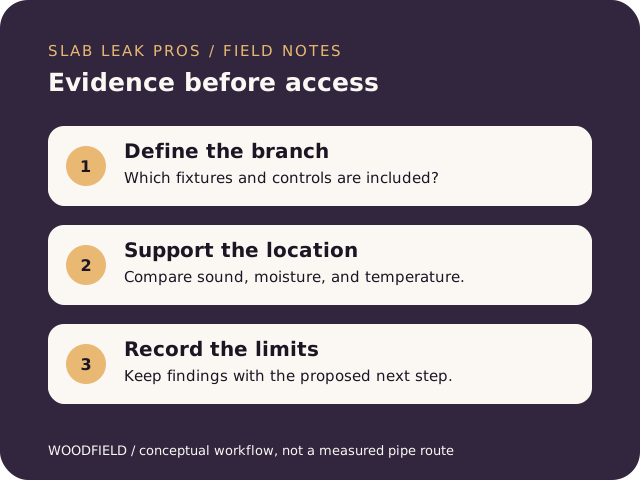
Our Placentia slab leak detection guide explains the wider testing choices. For Woodfield, ask for a finding that connects the affected branch with accessible testing points and the proposed next opening. That makes the result useful for repair planning rather than a collection of instrument readings.
Which clues belong in the detection brief?
Give each observation a place and time before treating it as evidence of a buried failure.
- Water use that remains unexplained. Note ordinary fixture checks and any irrigation or other known demand.
- A persistent water sound. Describe where it can be heard without pressing into a wet or unsafe space.
- A warm garage or room floor. Record recent hot-water use; warmth is an indirect surface clue.
- Dampness along a room boundary. Identify the first visible point, including adjoining wall or appliance connections.
- A changing supply symptom. Report affected fixtures rather than assume every room shares one branch.
A meter observation can indicate movement through the meter when known uses are off. It cannot identify the Woodfield room, distinguish every private branch, or prove who owns the leaking section. If the account covers more than one dwelling, a no-use test needs coordination to be meaningful.
Tell the inspector when the floor is dry despite the other signs. Water can appear away from its source, and a loss may be concealed without visible pooling. Conversely, an upstairs fixture or a garage appliance can create moisture without any under-slab defect.
How does the inspection work around an attached garage?
Start with accessible controls and evidence, then narrow the search without assuming the garage is the pipe route.
- Map the reported problem. Review fixtures, affected finishes, prior repairs, and the timing of water use.
- Define isolation. Identify authorized controls and what each test includes before changing water service.
- Check the branch. Suitable pressure or isolation tests help distinguish hot, cold, or another system.
- Compare location evidence. Listening, moisture readings, and thermal observations may support each other where conditions allow.
- State the limit. Record inaccessible connections, possible alternate sources, and what needs further investigation.
Acoustic equipment listens for sound associated with escaping pressurized water. Floor coverings and surrounding noise can affect interpretation. A thermal camera shows surface temperature differences; it does not see a hole through concrete. Ask which evidence supports the location and whether the slab type changes any proposed opening.
Clear a safe route to accessible garage controls without moving heavy storage or exposing live services. Do not remove finished flooring to help create a target. Once detection supports a repair opening, concealed features and any structural concerns need their own assessment before cutting begins.
What changes the detection cost and follow-up work?
Test access and the number of unresolved branches can matter more than the size of the visible wet patch.
| Accessible controls | Whether the affected dwelling and suspected branch can be isolated. |
|---|---|
| Surface conditions | Floor coverings, ambient sound, and the limits of indirect readings. |
| Additional access | Permission for a garage, neighboring space, or association-controlled enclosure if needed. |
| Written result | Tested boundaries, supported location, uncertainty, and proposed repair steps. |
Keep detection and repair authorization separate in the scope. Ask whether an exploratory opening is included and how any additional work is approved. For covered plumbing repairs, confirm the applicable permit requirements with Placentia Building and Safety. The association's response about access or exterior changes does not replace that process.
Which local details should be verified for this visit?
Use the actual address and property records to resolve supplier, access, and responsibility questions.
| County | Orange County, California. |
|---|---|
| Plumbing permits | City of Placentia Building and Safety for ordinary site-built residential plumbing; confirm the proposed scope. |
| Water supplier | Check the current bill or the utility's address lookup; neighborhood name alone is insufficient. |
| ZIP | 92870 is supported by community records; verify the service address. |
| Homes | Townhome examples with attached garages; one- and two-story layouts. Current foundation and pipe routes require inspection. |
What should you ask before and after detection?
Agree on the report before testing so the findings can support the next decision.
Ask which observations would confirm the suspected line, what happens if testing is inconclusive, and who must be present for controls or connected spaces. Check whether the planned water interruption affects only your home. Provide the current supplier details if a utility boundary question arises.
After testing, request the branch identification, location support, and any remaining uncertainty. Note which valves were changed and whether ordinary service was restored as intended. A location mark should be recorded with context before furniture or finishes hide it.
If a small repair is suitable, compare spot repair in Woodfield with the access and finish work it requires. A Woodfield slab leak reroute may be another route when replacing the buried path is appropriate. Detection should inform that comparison without guaranteeing either method before the conditions are known.
The Woodfield repair planning page brings the other service scopes together. We also explain the complete decision in our Placentia home guide to hidden pipe repairs, from first symptoms to verification and restored surfaces.
Which nearby guides raise different access questions?
Compare the diagnostic issues without assuming the same buildings or controls.
Slab Leak Detection questions in Woodfield
Woodfield detection questions often concern attached access, surface clues, and the limits of a location mark.
Does Woodfield townhome construction prove the leaking line is shared?
No. The tested branch and property information must establish which components are involved. Ask what the isolation result includes before assigning responsibility. An attached wall or garage does not settle that question.
Can the garage be checked without removing the floor?
Accessible controls and suitable instruments may allow useful testing before an opening. The inspector should explain any limits from finishes, noise, or missing access. Woodfield detection cannot promise a final location with no exploratory work in every home.
What if the warm patch moves between visits?
Record the timing and normal hot-water use rather than try to recreate the condition by running taps. The surface pattern is one clue. Branch testing and other observations should determine whether a pressurized hot-water loss explains it.
Is the inspection finished when a spot is marked?
The mark needs a supporting finding and clear next steps. Keep the tested line, uncertainty, access limits, and proposed repair investigation together. In Woodfield, include any garage or association access needed to act on the result.