
What does main water line repair address?
This page focuses on the incoming water-service piping associated with the property, with responsibility confirmed for the actual connection.
Main water line repair in Placentia, CA addresses a confirmed problem on the supply route bringing water toward the home. The suspect section may be outside the building, beneath hardscape, or near the building entry. It is different from automatically assuming the leak is an interior branch beneath the floor.
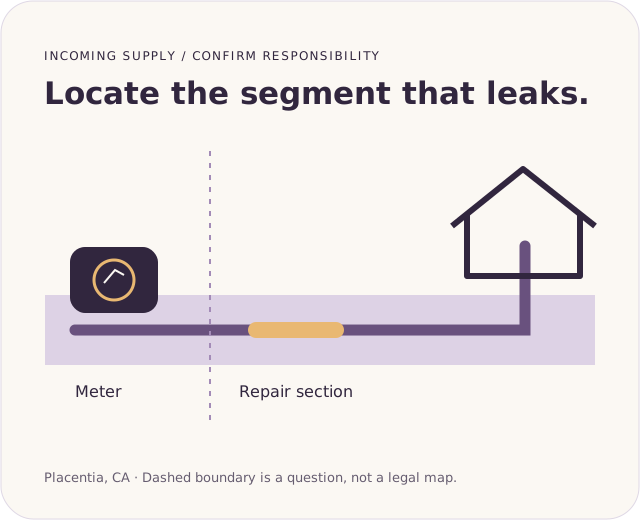
The street main, meter, utility connection, private service, and indoor distribution are related parts of a system. Their ownership and control need to be checked rather than guessed from where a puddle appears. Confirm the supplier and the service arrangement before authorizing work close to utility equipment.
We explain the incoming-line decision alongside our Placentia overview of hidden water-line leaks. The goal is to locate the active loss on the right segment, identify who can authorize the work, and compare access with restoration of the ground surface afterward.
How is a service-line leak distinguished from other water use?
The investigation needs a known meter and test boundary, not simply wet ground near the house.
Start by identifying which meter serves the property and what uses it measures. Irrigation or another building can complicate a simple indoor-versus-outdoor assumption. Ask the inspector to explain the system layout used for the test. A valve's location does not guarantee it isolates every branch thought to be downstream.
Appropriate isolation can help compare the incoming service with indoor use. This needs suitable controls and an understanding of connected equipment. Do not operate utility valves or shared controls as a homeowner experiment. If the test boundary is uncertain, the conclusion should remain limited until it is established.
Metered loss can support a customer-side investigation. Golden State Water's FAQs explain that water escaping before its meter is not recorded as customer usage through that meter. That billing distinction does not locate a leak, and the actual utility must confirm its responsibility boundary.
When evidence points inside the building instead, cold-water slab repair may be the more relevant route to investigate. A wet yard does not rule out an interior source, just as a dry yard does not prove the incoming line is intact.
Which changes should you report about the incoming supply?
Focus on where water appears, what the meter includes, and which fixtures or surfaces are affected.
Wet ground persists without recent watering
Describe the location and irrigation schedule. Surface water can travel, and the nearest buried pipe is not automatically the source.
The meter shows unexplained continuing use
Account for measured outdoor uses and automatic equipment. The observation warrants investigation but does not identify a specific service segment.
Pressure changes across much of the home
A service restriction, valve issue, utility condition, or leak could be involved. Note whether nearby normal operations changed at the same time.
Water emerges near the building entry
The entry is a useful reference point. The exact route and source still need to be confirmed before excavation.
A paved surface changes near a supply route
New damp joints, settlement, or visible damage should be documented from a safe position. Avoid standing on a surface that appears unstable.
A previous repair lies along the incoming path
Record the location and material if known. A repeat symptom can be compared with that work without assuming the new failure is at the same connection.
Outdoor use is off but the loss remains
An inactive controller does not prove every irrigation valve is watertight. The actual branches and controls need assessment.
Water approaches a public or shared access area
Explain the affected location promptly. Authority to close, excavate, or repair that area may involve parties beyond the occupant.
Why might an incoming water line need repair?
Material condition, connections, and prior site work can all shape the investigation.
A buried service can develop a pipe-wall failure or a problem at a joint. The line may include changes of material or previous replacement pieces. Ask which condition is observed at the failure and which explanation remains uncertain. The repair boundaries should use suitable material at both ends.
Earlier landscaping, additions, and utility work can make the present route different from a remembered straight line between the meter and house. Use records as clues, not as a guarantee that every buried section follows the sketch. A route needs appropriate locating before work near other underground services.
Surface conditions also affect access. A line under a lawn differs from one under a driveway or built-in outdoor feature. The source may be reachable while restoring the surface is the larger task. Compare those practical conditions before accepting the smallest pipe-repair price as the complete project cost.
Several repairs along an aging service can support comparing replacement of a longer section. That recommendation should identify the retained portions and why the new limits make sense. A single leak does not establish the condition of every connection between the utility and each fixture.
What must happen before the ground is opened?
The service route and nearby underground facilities require an appropriate locating and excavation plan.
Ask the excavator how the planned work area will be identified and how underground utility coordination is handled. DigAlert's operating procedures describe planned-excavation notification and marking context. Do not begin digging to find the leak before those responsibilities are resolved.
A utility mark or a route record should not be treated as a complete inventory of every private feature in the ground. Tell the contractor about irrigation, landscape lighting, drains, earlier additions, and any private installations known to you. Ask how unresolved lines within the work area will be addressed.
Keep meter boxes, sidewalks, and shared routes accessible without opening equipment or moving hazardous covers. Establish who has permission to work on each surface. A homeowner's approval for a lawn opening does not automatically authorize work on utility assets or a public right-of-way.
What can you arrange before the service-line visit?
Prepare the address, supplier, and affected-use details without trying to expose the pipe yourself.
Use the current water bill to identify the utility account and supplier. Photograph visible wet areas only from safe ground. Note the timing of irrigation, rain, and household demand so the inspector can separate those events. Do not keep a known active leak running just to preserve its surface appearance.
Find any older service-line invoices and sketches. Include known valve locations without assuming which ones belong to the utility. If several units use the connection, identify a management contact who can discuss authorized interruption. Arrange access to the building entry and affected outdoor area.
Ask how the household will manage the planned loss of supply. Service-line work can interrupt multiple indoor uses at once. Clarify any temporary arrangement directly and follow its limits. Equipment that depends on water may need appropriate professional attention during interruption and restart.
What should the main-line work sequence include?
A complete scope follows the supply segment from confirmation through safe return to use.
- Confirm the measured system and utility boundary. Identify the responsible parties before choosing the work limits.
- Locate the suspected loss. Relate the test findings to the actual incoming path and connected uses.
- Plan access and underground coordination. Address utility notification, other services, surfaces, and work-area permissions.
- Define repair or replacement. Compare a local section with a longer renewal where condition and history support it.
- Complete the relevant tests and approvals. Follow the applicable requirements before concealment and service restoration.
- Restore the site and hand over records. Clarify backfill, paving, landscaping, and any remaining completion work.
Keep the final route description and repair photographs. Ask what was checked at the indoor fixtures after supply restoration and what instructions apply to the completed work. Any flushing, disinfection, or service-return process should be specified by the responsible professional and applicable requirements, not improvised from general advice.
What affects service-line repair cost?
The route, ownership boundary, and site restoration can change the work as much as the pipe defect.
| Test and location work | Unclear branches or route records may require additional defined investigation. |
|---|---|
| Length and condition | One sound local repair differs from renewing a longer problematic segment. |
| Excavation and obstacles | Hardscape, other facilities, access limits, and buried features affect the plan. |
| Coordination | Utility boundaries, required approvals, permits, and shared occupants need assigned responsibility. |
| Site completion | Backfill, surface restoration, landscaping, testing, and return-to-use instructions should be included or excluded expressly. |
Check the covered plumbing requirements with Placentia Building and Safety. Public-area or utility work may need additional coordination; do not infer permission from an ordinary household repair quote.
What matters for incoming-line work in Placentia?
A complete service address is more useful than assuming every connection in one community has the same arrangement.
In Atwood, small-lot access makes the proposed staging and surface work worth clarifying before excavation. Describe the actual entry path and outdoor obstructions. Historical neighborhood descriptions do not establish the material or ownership of the service at a particular home.
For Corte Vista Villas, discuss compact outdoor access and any association involvement if a shared or exterior area is affected. Verify the actual control and pipe arrangement. Do not assign a utility or repair obligation from the community name alone.
When water is washing out ground, affecting safe access, or reaching a shared area, report the conditions promptly to the appropriate responsible parties. Avoid unstable ground and exposed electrical equipment. Seek urgent help for immediate danger. This site's reserved demo contact cannot dispatch service.
What should you ask about an incoming-line repair?
Clarify the supplier, segment, connected uses and final surface condition.
Is a leak near the meter always the utility’s repair?
No. The visible water location does not establish the failing component or responsibility. Contact the actual utility and identify the relevant service arrangement. Do not authorize work on utility equipment based only on where water appears at the surface.
Can irrigation make the service line seem to be leaking?
Yes. Outdoor branches measured by the same meter can complicate a quiet-period observation. An irrigation schedule being off does not prove every connected valve is holding. The test should establish which uses and branches are included before assigning the loss to the incoming line.
Will replacing the service line repair an indoor slab branch?
It renews only the segment defined in that project. A separate interior branch can remain unchanged and may need its own assessment. Ask the proposal to show the building entry and replacement endpoints so the work is not mistaken for an entire household repipe.
Should I dig down to the wettest spot?
No. Surface water can move away from its source, and buried hazards may be present. Let the appropriate locating and excavation process define access. A homeowner-created hole can damage another facility and remove useful evidence without reaching the failed pipe.
Does the utility shown for a nearby home serve mine?
Not necessarily. Placentia has more than one supplier, and service boundaries do not follow every neighborhood label. Confirm the account on your own bill and ask about the actual meter and connection. Sewer-service information alone does not establish the drinking-water supplier.
What should the completion record identify?
Keep the renewed segment, retained connections, route or access photos, relevant test and inspection records, and surface-restoration obligations. Include the party responsible for any remaining work. These details help a later investigation distinguish the incoming service from interior distribution and other buried uses.
Which main-line community guide helps with preparation?
Use local access context, then confirm the supplier and actual route for the address.
- Main Water Line Repair in Woodfield
- Main Water Line Repair in Cinnamon Tree
- Main Water Line Repair in Granada Park
- Main Water Line Repair in Placentia Village Groves
- Main Water Line Repair in Placentia Lakes
- Main Water Line Repair in Corte Vista Villas
- Main Water Line Repair in Northpoint at Alta Vista
- Main Water Line Repair in Old Town Placentia
- Main Water Line Repair in Atwood
- Main Water Line Repair in La Jolla
- Main Water Line Repair in Altura
- Main Water Line Repair in Bella Vista on the Green
- Main Water Line Repair in Alta Vista South
- Main Water Line Repair in Hamptons on the Green
- Main Water Line Repair in Mariposa Lane