
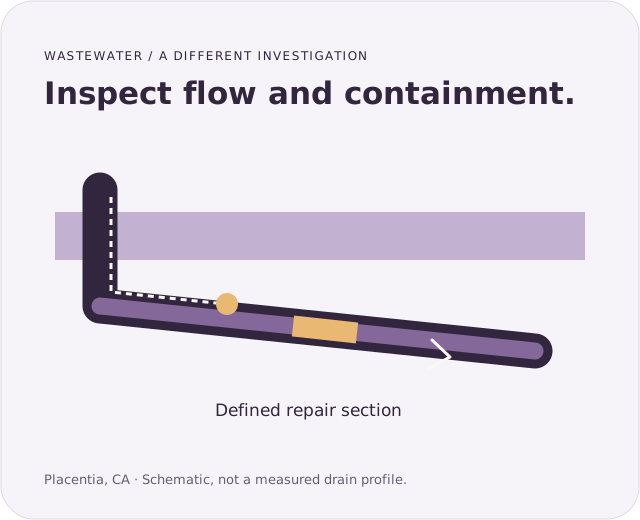
What is under-slab drain leak repair?
This service addresses wastewater piping beneath the floor, rather than the pressurized lines that deliver clean water.
Under-slab drain leak repair in Placentia, CA corrects a confirmed defect that allows wastewater to escape from buried drainage piping. The investigation follows fixture discharge and the drain route. A household water-meter test does not directly test the drain's ability to contain that wastewater.
A leaking drain and a blocked drain can occur together, but they are not the same finding. Clearing an obstruction may restore flow while leaving a damaged joint or pipe wall unresolved. Conversely, a slow fixture can have a local blockage without a buried leak. Ask the assessment to identify which condition the evidence supports.
We place this work within our Placentia guide to leaks beneath the floor so homeowners can distinguish supply repair from wastewater repair. The distinction changes testing, fixture-use precautions, access, and cleanup. It should be clear before a quote is accepted or the floor is opened.
How is a suspected drain leak investigated?
The inspector needs to connect the symptom with the drain route and the section under review.
Establish the fixture pattern
Record whether dampness, odor, or a backup follows use of a sink, shower, toilet, or laundry connection. Water can travel before appearing, so timing alone does not locate the defect. Different fixtures may join the same buried branch. The inspection should describe which parts of that arrangement are known.
Inspect accessible drainage
A cleanout provides an access point for certain inspection and maintenance tools. Its location and condition can determine which drain sections are reachable. A video camera can show the accessible interior and visible defects. RIDGID's drain-inspection equipment illustrates this type of investigation; a camera view is only the part of the system the equipment can reach and see.
Distinguish appearance from containment
A visible joint gap, crack, or standing water can justify further evaluation. The inspection should explain whether it demonstrates active escape or merely a condition needing another test. Appropriate professional drainage testing may be needed to establish containment. Do not treat a video alone as a guarantee about every concealed section.
If unexplained supply flow is also present, supply-line leak detection addresses that separate question. A home can have more than one problem. Keeping the findings separate avoids using a drain image to explain a supply-meter observation that it does not actually resolve.
Which signs should you describe before a drain assessment?
Use the pattern to guide the investigation while avoiding contact with suspect wastewater.
Moisture appears after a particular fixture drains
Note the fixture and delay before the symptom becomes visible. Avoid repeated use just to reproduce wetness that is already spreading.
Odor persists near a floor or drain area
Odor has several possible sources, including fixture traps and accessible connections. It calls for assessment, not an automatic conclusion that the slab drain is broken.
A backup involves more than one fixture
The pattern can help identify a shared drain route. A blockage is still a distinct finding from leakage through the pipe.
Dampness continues after a blockage is cleared
Restored drainage may not answer the containment question. Describe what changed and what remained after the earlier service.
A camera records an apparent pipe defect
Ask for the footage location and interpretation. A short clip should be tied to the inspected section and its limits.
Wastewater reaches occupied floor space
Keep people and pets out of the affected area. The response needs to account for contamination as well as the source.
An older drain repair is in the same route
Prior work can help identify transitions and access, but it does not prove where the current failure lies.
The floor symptom has no corresponding quiet-period meter movement
That observation cannot clear the drains. Wastewater piping needs a test suited to discharge and containment.
What can make a buried drain need repair?
The work should address the actual defect, not simply repeat drain cleaning when the pipe itself is damaged.
Drainage pipe can have a damaged wall, a separated connection, or an unsuitable transition. Some conditions interfere with flow; others allow wastewater to escape. The assessment should identify which mechanism is observed and which remains uncertain. A pipe material or age estimate alone cannot establish its present containment.
Alignment matters because gravity drainage relies on a workable path to carry waste. A camera image may show water sitting in the pipe, but interpreting the route and the cause requires context. Ask how any proposed correction will address the identified problem. Do not accept an unexplained claim that a larger pipe or more frequent cleaning solves a damaged section.
Remodeling and earlier repairs can change the layout. An added fixture may join a branch that is absent from the original plan. Keep available records, including prior camera reports and access photos. A location tied to a known cleanout and fixture group is more useful than a description such as “somewhere under the bathroom.”
When a local section needs replacement, access planning should also account for neighboring utilities and slab construction. The wastewater problem does not make concrete cutting routine. An appropriate assessment of embedded components and structural constraints is part of choosing a safe repair path.
What can you safely do before the visit?
Prepare information and access without opening a cleanout or testing containment yourself.
Avoid using the fixture associated with an active release until the responsible professional clarifies what is safe. If several fixtures may share the affected route, ask which uses should stop. Do not repeatedly flush or run a washing machine to prove that the symptom returns. That can add wastewater to the affected area.
Keep clear of water that may contain sewage. Move occupants away from it and avoid carrying contaminated items through clean rooms. Do not set up household fans to spread air from a suspect area. Ask for appropriate cleanup assessment rather than treating all floor wetness as clean supply water.
Show the inspector accessible cleanouts from a safe location, but leave caps and blocked piping alone. Opening a charged or backed-up drain can release wastewater. Do not insert plugs or attempt a homemade pressure test. Professional testing should have controls appropriate for the system and the risk.
Gather the symptom timing, fixture list, prior drain-service records, and building-entry details. If a common drain might serve another dwelling, identify a management contact. Authorization and coordination are important even when the first visible damage is inside your own unit.
How should access and replacement be compared?
A drain proposal needs to explain the section replaced, the functioning route, and the containment checks afterward.
Direct access may allow replacement of a short damaged section or connection. The scope should identify its endpoints and the condition of the adjoining pipe. If the route has a larger alignment problem, the correction may need more than a small patch. Ask what finding sets the replacement limits.
Repair options that work for a pressurized supply do not automatically work for a gravity drain. Any alternative route has to suit the drainage layout and applicable requirements. Do not assume that moving a waste line overhead is an equivalent substitute for bypassing a water-supply branch.
A lining or other rehabilitation method may be proposed for suitable conditions, but it needs a specific suitability assessment. Ask what it can and cannot correct, including any structural or alignment issue. Compare access, testing, cleaning, connection treatment, and final documentation rather than accepting a method label as a complete specification.
Our guide to planned slab access explains room-restoration questions that also matter here. The pipe methods differ, but the responsibility for concrete, drying assessment, cabinetry, and flooring still needs to be defined before work begins.
What should a drain repair visit cover?
Keep the source, discharge restrictions, and proof of completion clear throughout the work.
- Identify the affected fixture group. Link the symptom history with known cleanouts and drain branches.
- Inspect and define test limits. Record what equipment reached and any sections left unassessed.
- Agree on access and repair. Explain the defect, replacement boundaries, and how the method addresses flow and containment.
- Control fixture use and work hazards. Coordinate any shared occupants and contaminated areas.
- Complete appropriate checks. Resolve relevant testing and inspections before closure.
- Restore and document. Provide location records, completion findings, and the remaining cleanup or finish plan.
Ask for the before-and-after inspection records where relevant. A report should identify the repaired section in a way that can be found later. Restored flow is useful, but ask how the work's containment was assessed rather than treating a running faucet as the only completion check.
What affects under-slab drain repair cost?
Reach, pipe condition, and contamination-related work can change the project substantially.
| Inspection reach | Cleanout access, obstructions, and reachable branches affect what can be assessed before opening. |
|---|---|
| Defect and alignment | A local connection differs from a longer route needing correction. |
| Access area | Bathrooms, built-in finishes, embedded services, and slab conditions can expand exposure work. |
| Contamination | Cleanup and material handling may require a separate qualified scope. |
| Return to service | Testing, permit review, closure, and finish restoration need clear responsibilities. |
Confirm the applicable plumbing process with Placentia Building and Safety. Ask whether the price includes the required inspection stages and who coordinates them with closure and restoration.
What local details change drain-repair preparation?
Identify the actual building and fixture arrangement before assigning a buried failure to one dwelling.
In Cinnamon Tree, the floor level and connected-unit access are important opening details. An upstairs symptom may involve fixtures, walls, or a shared drain route rather than a slab below that unit. Arrange access with the appropriate authorized contact.
For Old Town Placentia, clarify whether the affected drain serves a residence, another occupancy, or a mixed-use arrangement. The planning area's building mix makes a uniform slab assumption inappropriate. Fixture mapping should follow the actual building.
Wastewater spreading into occupied space, loss of usable sanitary facilities, or water near electrical equipment needs prompt attention. Avoid the affected area and seek appropriate assistance. Do not rely on the site's fictional phone number for a live response or keep fixtures running while waiting for a routine inspection.
What should you ask about a buried drain repair?
Make the inspection limits, containment findings, and return-to-use conditions explicit.
Can the water meter show whether the drain is watertight?
No. It measures supplied water, not containment of wastewater after fixture use. A drain issue can remain with no unexplained quiet-period meter movement. The investigation must use methods suited to the affected drainage section and its symptoms.
Does clearing a clog repair a leaking drain?
Clearing an obstruction can restore flow without renewing a damaged pipe or connection. Ask whether the inspection found a containment defect and how it was assessed. If moisture persists, the earlier clearing result should be included in the next investigation rather than treated as proof of complete repair.
Is camera footage enough to approve replacement?
Footage can be strong evidence of a visible condition, but it needs location, scope, and interpretation. Ask what was seen, what was not accessible, and whether additional testing is needed to establish leakage. The repair proposal should address the observed condition rather than an unexplained image.
Should I open a cleanout to release backed-up water?
Leave that to an appropriate professional. A cap can retain wastewater, and opening it may create an uncontrolled release. Keep people away, limit affected fixture use as advised, and explain the backup when arranging assistance.
Will drain repair use the same bypass as a water line?
Not necessarily. Gravity drainage has different route and installation requirements from pressurized supply piping. A proposal must account for the drain layout and suitable connections. Do not assume the method used for a neighboring supply leak fits the wastewater system.
What should be checked before the floor is closed?
Ask for the relevant repair tests and any required inspection to be completed with suitable access. Confirm what cleanup or moisture assessment is needed and who approves readiness for restoration. Keep the pipe-location and completion records before the work disappears beneath new finishes.
Which local drain-repair guide helps you prepare?
Choose the community and identify the fixture group and building access involved.
- Under-Slab Drain Leak Repair in Woodfield
- Under-Slab Drain Leak Repair in Cinnamon Tree
- Under-Slab Drain Leak Repair in Granada Park
- Under-Slab Drain Leak Repair in Placentia Village Groves
- Under-Slab Drain Leak Repair in Placentia Lakes
- Under-Slab Drain Leak Repair in Corte Vista Villas
- Under-Slab Drain Leak Repair in Northpoint at Alta Vista
- Under-Slab Drain Leak Repair in Old Town Placentia
- Under-Slab Drain Leak Repair in Atwood
- Under-Slab Drain Leak Repair in La Jolla
- Under-Slab Drain Leak Repair in Altura
- Under-Slab Drain Leak Repair in Bella Vista on the Green
- Under-Slab Drain Leak Repair in Alta Vista South
- Under-Slab Drain Leak Repair in Hamptons on the Green
- Under-Slab Drain Leak Repair in Mariposa Lane