
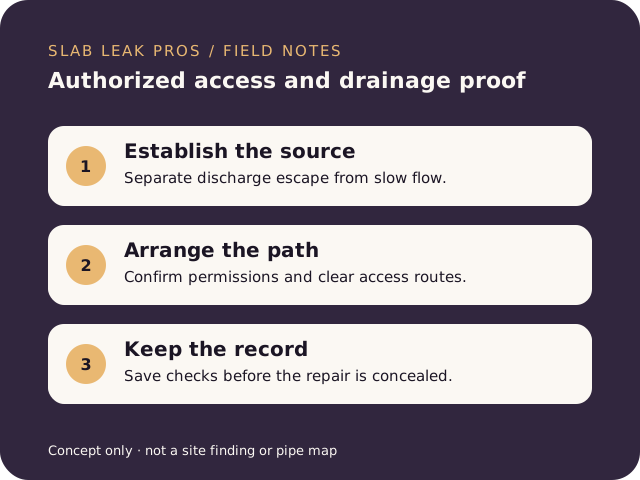
What drainage problem is the proposal intended to solve?
Name the defect and its location before discussing a method.
A drainage concern can involve flow, containment or both. A blocked fixture may begin draining after clearing while a damaged pipe section still needs assessment. Conversely, a stain near a drain does not establish an active leak. We would ask which findings explain the symptom and what remains uncertain.
Our guide to wastewater piping beneath floors separates this work from supply-line repair. A meter measures delivered water rather than the integrity of the waste route. Make sure an estimate does not use an unrelated supply observation as its only reason for opening a drain section.
Which observations make the source question clearer?
Keep fixture use, odor and visible wetting in separate notes.
Record whether a symptom follows a sink, shower, toilet or laundry discharge. Add the time it takes to appear if that is known from ordinary use. Do not create a fresh discharge to measure the delay. If multiple fixtures are affected, describe each rather than deciding that they must share a failure.
We also suggest noting previous cleaning, repairs and remodeling. A new fixture connection can matter to the current layout without proving faulty work. Odor by itself may have an accessible source and is not a buried-pipe diagnosis. Water that could contain sewage should be treated as a contact hazard while the source and cleanup needs are assessed.
How do camera findings become a repair decision?
An image should be explained in relation to the actual drain route.
Ask for the camera entry point, the reachable branches and the location of any visible defect. Deposits, turns or water inside the line can limit the view. The report should distinguish an observed condition from areas that could not be evaluated. Footage of one section cannot establish that every branch is sound.
If the inspection does not establish wastewater escape, ask whether further suitable professional testing is needed. Our Village Groves supply investigation guide covers a different type of evidence. We keep those findings separate so that a drain image is not treated as an explanation for unexplained incoming-water flow.
How should work access preserve clear community routes?
Plan the route to the repair while keeping emergency access unobstructed.
The association’s published material includes fire-lane and exterior-review context, which needs current confirmation. Ask where vehicles and materials can be staged without blocking required access. Do not assume that an interior repair permits storage outside another home or a change to shared surfaces.
The Placentia Village Groves access overview explains those coordination questions. Prepare a safe path to affected rooms without crossing contaminated water. Leave cleanouts shut, avoid chemical drain treatments and do not cut an exploratory opening. The person planning the work must consider the actual structure, neighboring services and permissions before destructive access begins.
Where access passes a connected residence, separate permission to enter from permission to alter a wall or surface. We would ask the plan to name the particular space and responsible contact rather than rely on a broad statement that management is aware. Work staging should also preserve a usable path for occupants who are not part of the repair. If the confirmed drainage route changes the access need, revisit that arrangement before expanding the work. Coordination is a practical requirement; it does not prove a pipe’s location or assign legal responsibility.
Which repair and restoration items need separate agreement?
A route correction can carry responsibilities beyond pipe replacement.
Ask the proposal to identify its start and end points and explain why that amount of pipe is included. If an alternative path is suggested, it must suit gravity drainage and the actual connections. A water-supply reroute is not a model that can simply be transferred to a waste line.
Our Village Groves supply-route guide offers comparison questions while preserving that distinction. For the drain proposal, itemize assessment, access, pipe correction, testing, contamination-related work and finish recovery. Confirm who handles permits and inspections. Exterior changes may also need association review; do not treat either process as proof of the other.
Which local records should guide preparation?
Use community facts to ask better questions without extending them to every building.
A documented single-story example gives useful context, but this page does not describe every Village Groves floor plan. Verify the fixture arrangement and prior alterations at the service address. We make no community-wide claim about slab reinforcement, drain material or soil conditions.
| County | Orange County, California. |
|---|---|
| Permit review | City of Placentia Building and Safety ordinarily reviews covered residential plumbing; confirm this repair’s scope and stages. |
| Water supplier | Identify supply service through the bill or official address search; the association name does not establish it. |
| ZIP | 92870 is supported for local examples; confirm the full address and unit designation. |
| Housing context | An attached single-story 1976 example is documented; check the actual layout and any later additions. |
Our Placentia resource for authorized drain repair access connects the local checklist with the wider repair decision. A known association does not determine who owns the line or bears its cost.
How can the handover make concealed work understandable?
Preserve the evidence before new finishes hide the repair.
Request the repaired-section location, relevant before-and-after images and an explanation of completion checks. The record should show how flow and containment were addressed, including any limitations. Keep required inspection records with the final scope and approved changes.
Ask who decides whether affected materials are ready for closure and finish installation. A functioning drain does not certify a dry wall or floor. Agree on any remaining fixture restrictions and communicate them to affected occupants. If odor or dampness persists, the next assessment needs the actual completion findings rather than a broad claim that the whole drainage network was renewed.
Which other local guides show different coordination needs?
Use another setting to test the completeness of your questions.
We provide separate drainage guides for layouts where the first issue may be an upstairs symptom or a garage access path. Those pages offer contrasts in preparation, without claiming the communities have the same pipes or failure rate. Keep this property’s findings at the center of the decision.
Under-Slab Drain Leak Repair questions in Placentia Village Groves
We focus these answers on community access, separate approvals and the meaning of a completion check.
Can shared walls tell us who owns a waste line?
We would not make that inference. Confirm the actual route and the applicable ownership documents with the responsible parties before assigning access authority, maintenance duties or payment.
Does an exterior route need only a city permit?
The actual work may also involve association permissions or other approvals. We recommend confirming each applicable process separately rather than assuming city review settles exterior access or ownership questions.
Will restored flow prove the leak was repaired?
Flow is one result. We would also ask how the repaired section’s containment was evaluated and whether any inaccessible areas or other suspected sources remain outside the finding.
Can equipment wait in a fire lane during the visit?
We recommend arranging an authorized staging location and preserving required access. Confirm current community rules with the appropriate contact rather than treating a temporary repair as permission to obstruct routes.