
What should slab leak detection resolve in Placentia Village Groves?
The inspection should identify the leaking system while keeping the access needed for later work visible.
Slab leak detection in Placentia Village Groves, Placentia, CA investigates a suspected hidden pipe loss before a repair route is selected. The goal is a supported finding about the affected line. A room with damp flooring may show where water arrives rather than where the pipe failed.
Community records include an association setting and an attached, single-story 1976 home example. These facts do not establish a uniform foundation or supply arrangement. They do make questions about connected spaces, work access, and exterior changes worth resolving for the actual property.
Placentia Village Groves has published guidance about exterior review and keeping designated fire lanes clear. Confirm the current directions for the planned visit. Testing equipment, parked vehicles, or a later repair staging area should be planned around required access, rather than becoming a last-minute obstacle.
We describe the diagnostic tools in the main slab leak detection guide. For Village Groves, the useful outcome combines source evidence with a clear account of the spaces inspected, controls operated, and further permissions needed to act on the finding.
Which signs should you report before equipment is brought in?
Describe the water pattern first; the easiest entry point may have no relation to the failing branch.
Report dampness by room and by the first point noticed. Include wall edges, nearby fixture connections, and changes after ordinary water use. If several surfaces are affected, show their order in photos instead of assuming that the largest patch is closest to the source.
A continued water sound or unexplained account use can prompt a supply investigation. Account for known indoor and outdoor demand before interpreting a meter observation. If a meter or control serves multiple spaces, a test intended to show no use needs the relevant occupants and authority involved.
Warmth at the floor is a useful detail when assessing a possible hot-water branch. Surface temperature depends on more than leakage, so a thermal image needs other evidence. Ask whether the suspected system is pressurized supply, drainage, or another source before discussing a slab opening.
- Changes in a particular fixture's flow or ordinary operation.
- Moisture that returns after the area was dried.
- A warm section that persists between normal hot-water uses.
- Prior repairs near the same room or supply connection.
- Outdoor wetting or appliance leakage that also needs to be excluded.
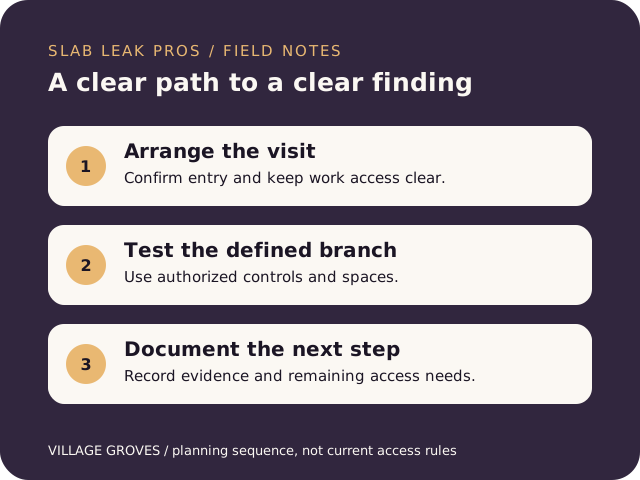
How can detection proceed without disrupting required access?
Plan entry and authorized controls before the inspection depends on them.
- Share the symptom record. Identify rooms, timing, and known pipe alterations.
- Arrange the work path. Confirm where vehicles and equipment may be placed without blocking designated lanes.
- Establish isolation. Identify the branch and every space affected by a proposed shutoff.
- Gather suitable evidence. Apply appropriate line tests and interpret location clues within their limits.
- Explain the next access. State whether more investigation or repair access is justified and who must authorize it.
Listening may help narrow a pressurized loss after the line has been identified. Noise, finishes, and paths through the building can affect the result. Moisture readings or thermal patterns can support the investigation, but neither proves the precise pipe defect through concrete.
Do not open a common enclosure or operate an uncertain shared valve simply to shorten the appointment. Confirm authority and access instead. If an area cannot be inspected, the written result should preserve that limit and name the additional step needed to resolve it.
Which local arrangements can change the work involved?
A detection scope should make the cost of unresolved access visible before it becomes extra work.
| Work route | Suitable entry and equipment placement while required access stays clear. |
|---|---|
| Control authority | Permission to isolate the intended line and coordinate any affected spaces. |
| Diagnostic stages | Included tests, written findings, and authorization for further investigation. |
| Later repair access | Any surface opening or changed exterior route that needs separate review. |
Ask whether the appointment includes only non-destructive testing or any proposed opening. For covered plumbing repair, confirm the applicable city requirements with Placentia Building and Safety. Association review of exterior work remains a separate question. Do not assume that an access permission also approves a permanent pipe change.
What information should be checked against the address?
Use current service and property records to settle details the community name cannot establish.
| County | Orange County in California. |
|---|---|
| Plumbing permits | City of Placentia Building and Safety for ordinary site-built residential work; scope-specific confirmation is needed. |
| Water supplier | Confirm the utility through the actual water account or address lookup. |
| ZIP | Community property evidence supports 92870; verify the dwelling address. |
| Documented home context | Association community with an attached single-story 1976 example. That example does not establish every layout, slab, or current line. |
What should be asked and checked after testing?
Retain a finding that can be understood when repair access is arranged later.
Before work begins, ask what will count as confirmation of the suspected line and how inconclusive results will be handled. Identify any required contact for adjacent or controlled spaces. Agree on who approves additional tests, a return visit, or an exploratory opening.
At handover, check the named branch, test boundaries, and support for the marked location. Keep photos that relate the mark to fixed room features. Confirm the final state of operated controls and any temporary water limitation. A location without this context may be difficult to use after furniture is replaced.
If a local opening is suitable, review spot repair in Placentia Village Groves for access and finish questions. If the failed route should be replaced elsewhere, the Village Groves reroute guide considers the full new path and any exterior change.
The Village Groves repair overview relates those choices to other services. Our Placentia guide to arranging a hidden-leak repair also explains why source confirmation, access, testing, and restored finishes belong in one understandable scope.
Slab Leak Detection questions in Placentia Village Groves
Village Groves detection questions connect equipment placement, pipe responsibility, isolation, and unresolved findings.
Why discuss fire-lane access for a detection appointment?
Equipment and vehicles still need a suitable place even before repair work starts. Placentia Village Groves has published directions about designated lanes. Confirm current arrangements so testing can proceed without obstructing required access.
Does exterior approval establish who owns the leaking pipe?
No. Approval for a proposed surface or route change and responsibility for the failed component are separate questions. Use the identified line and relevant property information to clarify both before authorizing the repair.
Can an attached single-story layout guarantee simple isolation?
The layout alone does not reveal how the active supply is connected. Test boundaries and controls must be checked at the Village Groves home. Earlier alterations may also change what a particular valve serves.
What should an inconclusive detection result include?
It should name the limits, such as unavailable spaces or a branch that could not be isolated, and explain the next useful test. Keep that information with the observations rather than treating an unsupported location as ready for cutting.