
What should Woodfield homeowners establish first?
Trace the line serving the affected rooms before deciding how access or responsibility should be handled.
Slab leak repair in Woodfield, Placentia, CA begins with the individual townhome's plumbing arrangement. An attached layout and garage access can shape testing and replacement routes. They do not establish that the failed pipe is shared or that an association pays for it. Start with the affected fixtures and the actual route identified by the inspection.
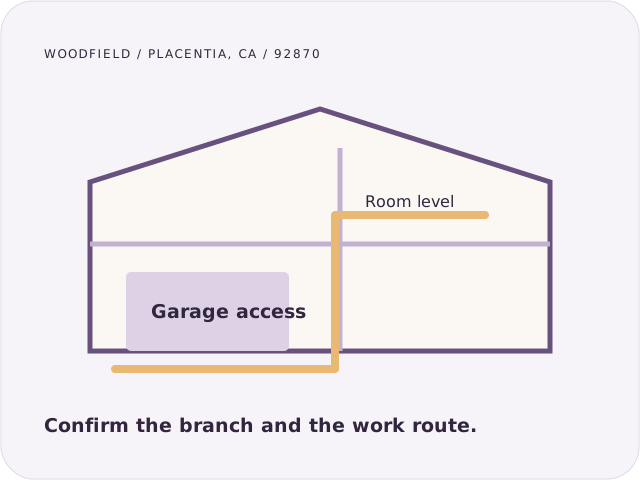
Woodfield has documented one- and two-story townhome layouts with attached garages. That makes the room level and garage connection useful details to provide. A warm or damp floor in one room should be assessed alongside possible fixture and wall sources. Do not assume that moisture in an upper room originates beneath the home's slab.
We focus this guide on repair decisions that follow those findings. Our Placentia slab repair planning resource explains the overall choices. For a Woodfield property, compare how each method reaches the affected line while protecting adjoining rooms, garage finishes, and any surfaces requiring permission.
Which problems need careful source checks in an attached home?
The relationship between rooms can be as important as the visible size of a wet area.
A patch beside a shared wall needs a source investigation, not an immediate conclusion that another unit is responsible. Water can follow an interior wall, floor edge, or pipe route. Note where it first appeared and which side is accessible from your dwelling. Tell the inspector about adjacent fixtures or known repairs without entering another unit.
A garage symptom may sit near supply lines or the route to household fixtures. Record whether the garage is finished and what access is available around stored items. The inspection should distinguish water from a domestic line, an appliance connection, or an exterior source before proposing a slab opening in that area.
Unexplained water use, a persistent warm area, or changing flow at several outlets can support further testing. Each clue needs context. A meter serving more than one use cannot be interpreted as though only one bathroom is connected. Ask who can clarify any shared supply and authorize a controlled interruption.
Where wastewater is suspected, relate the symptom to the fixture that was draining and avoid contact with the wet area. The absence of meter movement does not clear a waste line. Source-specific testing prevents a supply repair from being selected for a drainage problem with a different route and cleanup need.
Which services may fit a Woodfield line problem?
The appropriate scope follows the line and its condition, rather than the community’s building age.
Detection before a destructive opening
Slab leak detection can help define the affected branch and narrow a hidden source. For an attached townhome, ask which sections were isolated and whether the test requires another occupant's cooperation. Keep the location finding and any remaining uncertainty together.
A replacement route for one branch
A slab leak reroute can be worth comparing when the failed path is difficult to reach from the floor. Describe available garage, wall, and ceiling access. The new route needs suitable endpoints and installation details; a neighboring townhome's solution does not prove the same path works here.
A wider supply replacement
Whole house repiping becomes a different discussion when a documented pattern spans several supply branches. Ask which fixtures and retained lines are included. A larger proposal should account for water availability during the project and all room-restoration work, not just the new tubing.
Repairing wastewater containment
An under-slab drain repair follows evidence about the drainage system. Accessible cleanouts, fixture grouping, and any shared route affect investigation. A camera may show a defect, while appropriate additional testing may be needed to establish leakage. Keep the drainage findings separate from any pressure-supply result.
What should the repair sequence cover?
Use a scope that connects the findings, unit access, pipe work, and restoration.
- Identify the dwelling and affected level. Describe the room, nearby fixtures, garage access, and recent symptom changes.
- Confirm the tested system. Establish the supply or drain involved and any shared-control questions.
- Compare access options. Mark the proposed floor or wall openings and the surfaces affected by a new route.
- Resolve permissions and approvals. Clarify any association review and the applicable city permit or inspection process.
- Verify the completed pipe work. Collect the relevant tests and records before access is closed.
- Finish the affected areas. Coordinate drying assessment, garage or interior patching, and any remaining surface work.
For ordinary covered residential plumbing, Placentia Building and Safety is the local permit contact. Confirm the actual scope requirements. Association approval addresses different matters from a city inspection, and neither should be assumed from a verbal statement that the work is “inside the unit.”
What should you have ready for a Woodfield visit?
A compact set of facts can make the initial assessment more useful.
- Full address and unit details, plus safe entry instructions.
- Which room and floor first showed the symptom.
- Whether the garage and nearby plumbing points are accessible.
- Known branch repairs and any plans from earlier alterations.
- The water supplier shown on the current bill.
- An association contact if common surfaces or shared controls may be affected.
- Safe photographs and the timeline of visible changes.
Do not clear heavy stored items from a wet garage or open the floor to help find the pipe. If water is spreading or electrical equipment is threatened, prioritize leaving the affected area and seeking appropriate assistance. The preview's telephone is fictional and cannot arrange an urgent visit.
Which other Placentia guides may help frame the questions?
Compare the access questions while keeping each property's actual layout distinct.
The Cinnamon Tree guide addresses floor-level and connected-unit considerations in condominium buildings. It can help frame a question about water from above, but it does not establish the plumbing configuration of a Woodfield townhome.
The Northpoint at Alta Vista guide considers one- versus two-story route questions. Use it to prepare a layout discussion, not to assume a bypass designed for another building can be copied into yours without assessment.
Which Woodfield service guide matches the confirmed problem?
The full set below separates diagnosis, repair methods, materials, and the affected plumbing system.
- Slab Leak Detection in Woodfield
- Emergency Slab Leak Repair in Woodfield
- Hot Water Slab Leak Repair in Woodfield
- Cold Water Slab Leak Repair in Woodfield
- Slab Leak Spot Repair in Woodfield
- Slab Leak Reroute in Woodfield
- Whole House Repiping in Woodfield
- Copper Pinhole Leak Repair in Woodfield
- Under-Slab Drain Leak Repair in Woodfield
- Main Water Line Repair in Woodfield
Slab Leak Repair questions in Woodfield
Use the findings at the home to resolve the details before work begins.
Does an attached Woodfield home automatically have shared water pipes?
No. Attached construction does not identify the ownership or route of a particular line. Establish which fixtures and unit the pipe serves, then review the relevant property documents and authorized contacts. Testing and responsibility should not be decided from the shared-wall appearance alone.
Can the garage offer a route around a failed slab branch?
It may provide useful access in some layouts, but the endpoints, available space, and installation requirements must be assessed. Describe the actual garage and finishes. A route that worked in another Woodfield home is a comparison idea, not a ready design for this property.
Should I notify the association before testing?
Ask about coordination when testing may use shared controls, affect common access, or require entry beyond your dwelling. The need depends on the actual scope. Have a contact available rather than assuming every diagnostic task either always requires approval or never involves the association.
How should a quote handle interior and garage patching?
Identify each opening and the party restoring it. Concrete repair, drywall, paint, and flooring can be separate tasks. Agree on matching and drying-readiness questions before the work starts, so the plumbing scope leads to a defined finished condition rather than an unspecified collection of patches.
Does Woodfield's housing history prove the pipe is original?
No. Earlier replacements, additions, and individual maintenance can change the active plumbing. Use records and inspection of the actual dwelling to identify materials and routes. The community’s development period supplies background, not a diagnosis of present pipe condition.