
Why arrange slab leak detection in Granada Park?
A supported location helps compare a limited floor opening with replacing the affected pipe along another path.
Slab leak detection in Granada Park, Placentia, CA should establish whether a concealed pressurized line is losing water and where repair access is justified. The service is useful before a finished floor is opened. The wettest surface is an observation, not a reliable cutting plan.
Available Granada Park records include predominantly 1970s detached homes in a gated association setting. That housing history makes earlier repairs worth reviewing, but it does not establish pipe material or condition. A remodeled room may contain a changed supply route that original construction information cannot describe.
Detection can narrow the uncertainty behind two very different repairs. A localized failure may support a small replacement where access is suitable. A bypass may replace the failed route when a floor opening is less practical. Both decisions need the affected branch identified before their complete scopes can be compared.
Our guide to slab leak detection methods explains what listening and isolation contribute. In Granada Park, ask how the location evidence relates to existing flooring, possible access points, and the connections a replacement path would need.
Which warning signs help narrow the inspection?
Keep surface changes separate from conclusions about the line beneath them.
Record where dampness first appeared, including the edge of a room or a transition between finishes. Mention adjacent appliances and plumbing walls. Water can travel from its source before it becomes visible, so a straight line from the stain to the nearest fixture may be misleading.
A warm area deserves a hot-water branch check when other evidence supports it. Describe whether it persists between normal uses. Do not run extra hot water to make an image more dramatic; thermal readings show surface heat patterns, not a pipe opening inside concrete.
Unexplained use on a bill can support an investigation, especially after ordinary fixtures and known outdoor demand are considered. Supply noises or pressure changes may add context. None of these signs alone establishes the depth of the pipe or the size of a future opening.
- Save dated photos showing the first wet finish and any later spread.
- List fixtures with changed performance and those working normally.
- Bring records of earlier floor patches or rerouted branches.
- Report recent appliance, bathroom, or irrigation changes.
- Identify any control whose purpose or reach is uncertain.
How does detection inform a finished-floor decision?
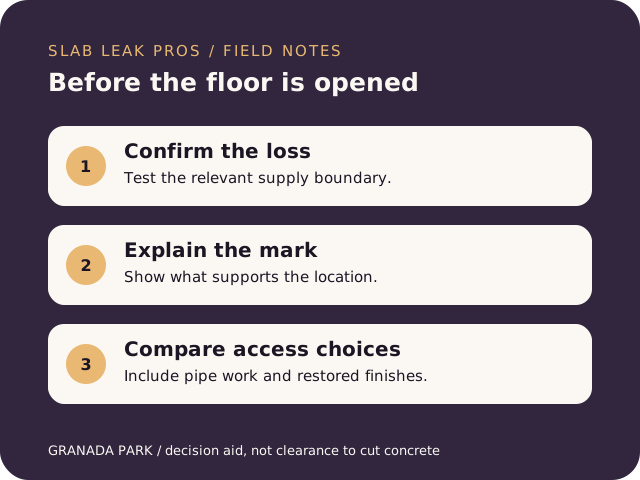
The inspector should connect controlled testing with a location that can be explained and recorded.
- Review the room history. Compare symptoms with prior pipe and finish work.
- Establish the tested supply. Identify suitable accessible controls and the branch served.
- Assess the suspected loss. Use appropriate isolation or pressure checks within a defined boundary.
- Locate supporting evidence. Interpret acoustic, moisture, and thermal findings in the actual surface conditions.
- Outline the next decision. State where access may be needed and which uncertainty remains.
Floor coverings and background sound can influence the available location evidence. Ask what supports the marked point and whether an alternate source was excluded. A clear report explains limits instead of turning one instrument reading into a promise of exact access.
If concrete access is proposed, the slab and concealed features require a suitable assessment before cutting. A detection mark is not clearance to drill through an unknown structural feature. Keep the diagnostic result and the opening plan as related but distinct decisions.
What belongs in a Granada Park detection quote?
Specify testing, findings, and additional-access authorization before discussing the permanent repair price.
| Testing reach | Which supply branches, fixtures, and accessible connections are included? |
|---|---|
| Floor conditions | How do finish layers or room access affect the evidence and investigation? |
| Additional work | What happens if an exploratory opening or a return visit becomes necessary? |
| Result format | Are the supported location, uncertainty, and next repair choices recorded? |
Arrange the gated entry and identify the property contact before the appointment. If later work changes an exterior route or controlled surface, clarify current association review. Confirm covered-plumbing permit requirements with Placentia Building and Safety for the actual repair. Do not infer an exemption or a guaranteed permit schedule from a detection-only appointment.
Which local facts belong with the work order?
Address-specific information helps resolve the water account and access arrangements.
| County | Orange County, CA. |
|---|---|
| Plumbing permits | City of Placentia Building and Safety; confirm requirements for the covered repair being proposed. |
| Water supplier | Use the property's current bill or verified utility address information. |
| ZIP | 92870 in available community records; validate the full service address. |
| Typical documented homes | Detached single-family examples, largely from the 1970s. Gated association access is documented; foundation and current piping vary by property. |
What should you compare after the leak is traced?
The location should support a complete repair discussion, including the surfaces each option affects.
Ask whether the report identifies one failing branch or leaves a broader supply question unresolved. Check how the location was marked and which references make it recoverable later. If water remains isolated, understand the temporary service arrangement before assuming the home is back to normal.
A Granada Park spot repair may concentrate work around a supported failure point. Compare its opening, pipe replacement, testing, concrete patch, and flooring scope. A small pipe defect does not guarantee a small finish-restoration obligation.
A reroute in Granada Park needs suitable connections and a complete replacement path. Compare wall or ceiling access with the local floor option. Detection should clarify the problem both options address, while the route assessment establishes whether each method is suitable.
Our Granada Park repair guide covers the wider service choices. We bring source, access, and finish questions together in the Placentia guide to planning floor-access repairs so the final decision accounts for more than the pipe connection.
Which guides explore related detection decisions?
Compare the access question while keeping Granada Park findings specific to the inspected property.
Slab Leak Detection questions in Granada Park
Granada Park homeowners can use these answers to prepare finished floors, interpret house age, and retain useful findings.
Should Granada Park flooring be removed before the inspection?
Usually the source assessment should guide any required opening. Preserve safe access and records of the affected finish, but do not remove flooring just to expose a guessed location. Confirm what testing can establish first.
Can detection choose between spot repair and a reroute?
It supplies key evidence about the failing branch and suspected point. The final choice also needs access, connection, condition, and restoration assessment. In Granada Park, compare the complete floor and alternate-route scopes after those facts are available.
Does a 1970s home always have its original buried line?
No. Repairs and remodels may have replaced or bypassed part of the system. Bring any available records and describe known changes. Construction era alone cannot establish the active pipe route in a Granada Park home.
What should I retain after the detection appointment?
Keep the branch finding, marked-location references, test limits, and next-step proposal. Record temporary water restrictions and any operated controls. These details help the later repair scope use the diagnosis without repeating assumptions about finished-floor access.