
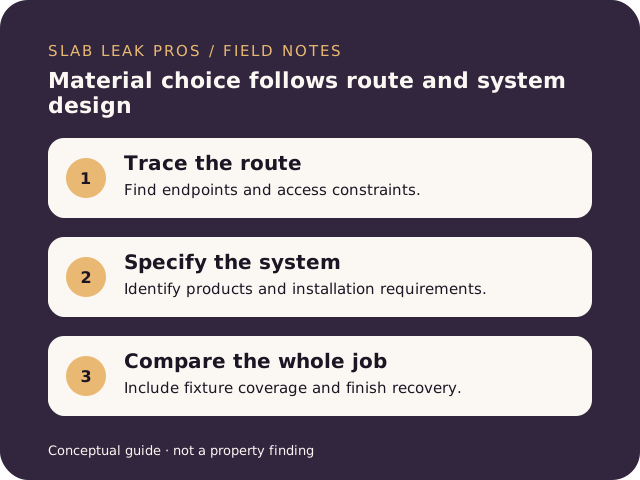
Why should the route come before the material choice?
A product cannot solve an unsuitable path through the building.
Draw the proposed start and finish points before comparing product claims. The new line may need to cross rooms, turn around framing or reach fixtures on another level. Ask where connections will be made and which surfaces must open. A convenient-looking path on a sketch may contain structural, access or permission limits that need review.
Our slab leak reroute guide describes how a bypass replaces the function of an affected line. It also explains why a reroute does not automatically mean a whole-house repipe. Keep those scopes separate while comparing materials. A quote for one branch should not be compared directly with a quote for all hot and cold distribution piping simply because both list the same type of tubing.
What should a material specification tell you?
Look beyond a one-word material description.
Ask for the proposed pipe product, size and connection system. The installer should account for the intended water service, operating conditions and applicable approvals. Instructions for a particular product matter. Fittings, valves and tools need to belong to a compatible installation approach, rather than a collection of parts selected by name alone.
The Plastics Pipe Institute installation guidance calls for reviewing local requirements and the system manufacturer's instructions before installation. Its advice also covers ratings, protection and material compatibility. This is trade-body guidance about PEX, not proof that every product is suitable for every home. We would ask the proposed installer to identify the relevant requirements rather than infer them from a generic comparison chart.
How do surroundings affect the proposed installation?
The spaces around a pipe can matter as much as the pipe itself.
An overhead path can involve heat, sunlight exposure, stored items and nearby equipment. Wall routes can place piping close to fasteners, penetrations or incompatible materials. The design should explain how the system is protected at those points. Do not treat a concealed location as automatic protection from every condition.
PPI warns against direct or reflected sunlight exposure and identifies chemical-contact restrictions for PEX systems. The exact product instructions still govern the installation. We do not turn these precautions into a claim that one material always fails sooner than another. Our Mariposa Lane repair access guide illustrates the value of checking the actual garage-to-fixture path without assigning a standard layout or pipe material to every address.
Will the new line serve the fixtures as intended?
Ask about performance at the fixtures, rather than material slogans.
The proposed line should suit the demand it serves. Its length, size, fittings and route belong in that discussion. A material swap alone does not prove better pressure or faster hot-water delivery. A longer replacement route can change the amount of water between a heater and a fixture. Have the design implications explained before the path is accepted.
We recommend identifying which fixtures depend on the bypass and whether any connections will remain on older piping. The Mariposa Lane reroute planning page focuses on those endpoints and access questions. Check them against the property's actual system. No neighborhood name can establish whether an attic is suitable, which branch serves a bathroom, or whether a proposed line has enough capacity.
What makes two material proposals fairly comparable?
Hold the repair boundary and finish scope steady.
One proposal may include wall repair and painting while another stops after the plumbing work. One may cover all affected branches while another bypasses just one line. Ask for the same included work in each proposal before interpreting the price difference as a material difference. Record exclusions in plain language.
Our Placentia guide to selecting a replacement pipe route places the material question beside access, condition and recovery. We would also ask who obtains required permits, what inspections apply, and how the line will be tested using an approved method. Testing is professional work; a homeowner should not improvise pressure equipment or choose a test pressure from an online chart. The selected system's requirements and local rules need to be followed.
What promises should you examine carefully?
A broad lifespan claim is less useful than documented installation and warranty terms.
Avoid assuming that either material is immune to damage or guaranteed to last for a fixed number of years. Product warranties and workmanship terms can have different issuers, conditions and exclusions. Ask for the actual written terms if a proposal includes a warranty. A general statement about an industry product is not a warranty from this website.
After work, keep the product identification, route photographs when available and the final list of connected fixtures. Ask how the abandoned under-slab section was addressed and what remains in service. Those records help future professionals work around the new piping and understand later symptoms. Choosing material is one part of the repair; preserving the installed-system details makes that choice useful over time.
Questions about this guide
Is PEX always the better reroute choice?
We would not choose by material name alone. Route conditions, product requirements, system design and the actual scope all affect whether a proposal fits the home.
Does copper guarantee that another leak cannot happen?
No material choice provides that guarantee. We recommend asking about the proposed system, installation details and written warranty terms rather than relying on a lifetime claim.
Can the new route change hot-water waiting time?
A changed path can alter the water volume between the heater and fixture. We suggest asking the designer to explain the proposed length and layout.
Should we test new piping ourselves?
No. We leave pressure testing to qualified professionals using methods permitted for the installed system. Improvised testing can create serious hazards.