
What does the timing of the moisture tell you?
Patterns can guide an investigation without proving the answer.
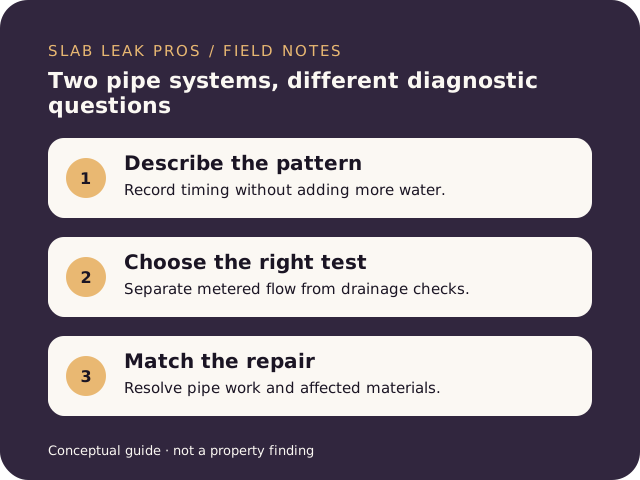
Write down when the area appears wetter and what happened beforehand. Shower use, laundry, irrigation, rainfall and continuous household use can each provide useful context. A symptom that follows a fixture's use may suggest a place to investigate. It does not prove that the drain beneath that fixture is leaking; nearby supply connections or surface waterproofing may also matter.
We recommend noting whether the patch changes while the household is quiet. Describe observations without repeatedly operating a fixture that may be leaking. Our under-slab drain leak guide explains the waste-line investigation. Avoid labeling water as clean from its appearance alone. If sewage or other contamination is possible, keep people away from the affected area and seek appropriate professional help.
What can a water-meter observation establish?
It measures water passing the supply meter, not the condition of every hidden pipe.
The EPA WaterSense leak checklist recommends comparing meter readings across a two-hour period with no water being used. A change suggests a leak or other unaccounted use. Automatic irrigation, ice makers, appliance cycles and a running toilet can disrupt the no-use assumption. Shared meters add another limit because another household's use may be included.
A meter cannot show where the water went. It cannot distinguish an under-slab branch from a yard line or a fixture leak on its own. It also does not directly test a drain, which carries water after use. Our cold-water supply leak explanation keeps that boundary clear. A quiet meter during one observation is not a clean bill of health for the building's drainage.
What does a drain camera show?
An image of the pipe interior answers some questions and leaves others open.
A professional may use available cleanouts and inspection equipment to examine reachable sections. The view can help document internal conditions or identify an obstruction. Access, turns, deposits and standing water can limit what is visible. Ask which sections were actually reached and whether the investigation addressed the symptom you reported.
RIDGID's inspection equipment information describes tools for viewing drain and sewer interiors. Equipment capability is not proof that this site owns a particular tool or that a camera alone establishes watertightness. A recorded defect and a confirmed leak are different findings. Ask whether further testing is needed and who will interpret it. Do not pour chemicals into a suspected leaking drain or try to seal and pressurize it yourself.
Could the moisture come from somewhere else?
A useful investigation keeps reasonable alternatives in view.
Water may enter from a wall, appliance connection, roof or exterior drainage problem. A floor finish can conceal the path it followed. Odor can prompt a drainage check but cannot, by itself, locate a broken buried pipe. Warmth may point toward hot-water activity while still requiring confirmation. Several systems can have problems at the same time.
Our Placentia Lakes source-checking guide discusses separating household supply concerns from other water sources. It does not assign a cause to a particular home. Bring photographs and a brief timeline to the assessment, and identify nearby fixtures without treating proximity as proof. We find a source-neutral description more useful than a firm diagnosis based only on a stain.
How should the investigation be explained to you?
Ask what each proposed test is intended to rule in or rule out.
A clear plan names the suspected system, the portion being examined and the limits of the result. For a supply concern, the investigator may discuss isolating parts of the system and checking their response. For a drainage concern, access and the condition of reachable pipe may guide the next test. The methods must suit the building and be performed safely.
The Placentia Lakes under-slab drain page organizes waste-line access questions. For the wider decision, see our Placentia guide to distinguishing hidden pipe systems. Neither guide supplies a do-it-yourself testing procedure. Ask for findings in plain language, including what was not examined and what remains uncertain before any destructive opening is proposed.
Why does the system distinction change the repair plan?
The affected pipe and any contamination shape the work that follows.
Supply repair needs a defined connection back to sound, active distribution piping. Drain repair needs an appropriate drainage arrangement and attention to the affected waste-line section. Access may involve different rooms or surfaces. A method chosen for a pressurized water branch cannot automatically be applied to a drain simply because both lie beneath concrete.
After the source is addressed, evaluate the surrounding materials separately. A pipe test does not establish that a floor assembly is dry or that contaminated materials have been safely handled. Ask how plumbing work, moisture recovery and finish restoration fit together. This avoids closing an opening while an unresolved condition remains nearby. Keep the diagnostic record so that later dampness can be assessed against what was actually found and repaired.
Questions about this guide
Does a stopped water meter rule out an under-slab drain leak?
No. We use meter information to discuss supply flow. Drain integrity needs an investigation of the drainage system and the reported conditions.
Can a camera prove the entire drain is sound?
We would ask which sections were visible and what limits applied. A camera view alone does not automatically establish that every concealed connection is watertight.
Does a sewer smell identify a broken pipe under the floor?
Odor is a reason to investigate. We do not treat it as proof of the location or cause of a drain problem.
Should we keep running fixtures to reproduce the leak?
We would avoid adding water to a suspected active problem. Document the existing pattern and arrange a safe assessment instead of repeated experiments.