
What does your leak history actually show?
Start with a map of events, rather than a count alone.
Two leaks can have very different meanings. One may be a new failure on another branch. Another may involve a connection near an earlier repair. A third damp patch may come from a shower or drain, without any new supply failure. We would separate those events before treating them as evidence for a whole-home project.
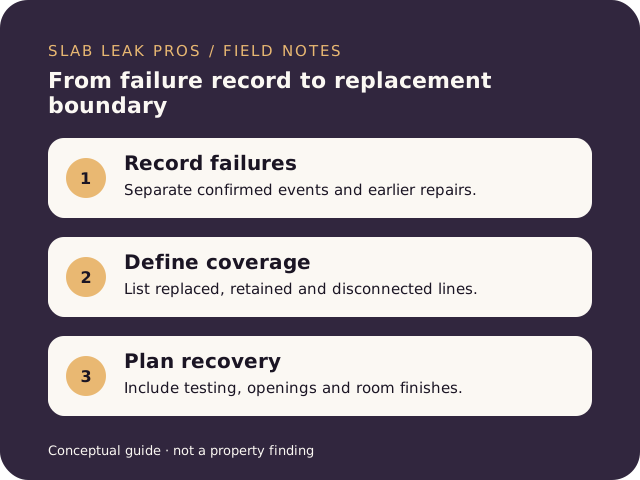
Collect the dates, locations, available photographs and invoices from earlier work. Ask whether each event was confirmed as hot supply, cold supply, drainage or another source. Mark which sections were replaced and which were left in use. A rough room sketch is useful even when it cannot show the exact buried route. Our whole house repiping guide explains how to define the network a replacement proposal should cover.
What do we know about the pipe that remains?
A removed piece can inform a discussion without representing the whole building.
Ask the person assessing the plumbing to explain what was observed and how far that finding can reasonably be applied. A photograph of a damaged section may document a local defect. It does not establish a failure date for every other branch. Distinguish direct observations from estimates based on age, repair history or inaccessible conditions.
The kind of evidence matters too. A reported drop in pressure needs a defined test boundary. A visible perforation needs its location and surrounding condition recorded. Reports of noisy pipes or slow hot water need separate investigation. If the concern is copper deterioration, our copper pinhole leak explanation helps frame the questions without assigning an unproved cause to Placentia water. Ask what remains unknown and whether that uncertainty changes the recommended scope.
Which pipes would a repipe actually replace?
The label on an estimate should be supported by a clear list of included connections.
Walk through the served fixtures on paper. Kitchen, laundry, bathrooms and outdoor connections may have different paths. Some parts may already have been renewed. A proposal should identify its starting point, its termination points and any retained segments. Ask whether the incoming service line, fixtures, water heater connections and irrigation feeds are included or excluded.
Ownership and authority also need attention when plumbing passes through connected spaces. Our Cinnamon Tree repair planning page discusses access and authorization questions. A community name cannot settle which pipe belongs to which owner. Resolve that through the applicable records and responsible people. A technically possible route still needs permission for the rooms, surfaces and shutoffs involved.
How should you compare a limited repair with wider replacement?
Put the same present problem at the center of both proposals.
A limited approach may replace the confirmed failed section or bypass one affected branch. A broader approach may renew more of the distribution system. Ask each proposal to explain how it stops the current loss, what remains active, and what evidence supports its reach. A useful comparison includes the disruption and the retained uncertainty, as well as the pipe work.
For example, a family may be able to tolerate a planned water interruption now but struggle with repeated unplanned access later. Another home may have a recently renewed system with one isolated connection problem. These are decision examples, not predictions about a property. We bring those choices together in our Placentia resource for evaluating repair scale. There is no sound rule that a certain number of leaks always requires a full repipe.
What should be written down before work starts?
Room recovery deserves the same attention as the new piping.
Request a description of access openings, protection for occupied rooms, expected water interruptions and the sequence of work. Ask who handles plumbing permits and inspections where required. Define patching, texture, painting, flooring and cleanup rather than assuming the word repipe includes each task. Product descriptions should identify the proposed system and the installation requirements that apply.
The California Contractors State License Board recommends comparing written bids based on the same plans, specifications and scope. That principle is especially useful when proposals cover different amounts of pipe. Our Cinnamon Tree repiping scope guide gives a place-specific way to organize those questions without assuming shared plumbing or a particular pipe material.
What records help after the repipe is finished?
Make the final arrangement understandable for the next repair decision.
Keep the signed scope, approved changes, product information and any inspection records. Request a simple description of the new route and of old lines taken out of service. Record exceptions clearly. If an inaccessible section stayed in use, its presence should not disappear behind a broad project label. Save photographs taken before openings were closed when they are available.
Ask how the installed work was checked and whether all listed fixtures were restored to service. A completed plumbing test does not certify that flooring or wall cavities have dried. Moisture recovery may need its own assessment. Repiping can address the distribution system within its stated scope, but it cannot establish that every future source of water damage has been removed. Good records keep that boundary clear.
Questions about this guide
Does a second slab leak mean we need a whole-house repipe?
We would first confirm whether it is a separate supply failure and review the remaining system. A leak count alone does not establish the right replacement scope.
Can a repipe leave any original piping in place?
It can, depending on the agreed scope. We recommend identifying every retained section and connection so that whole-house wording does not hide exclusions.
Should we compare more than the pipe price?
Yes. We would compare access, water interruptions, permits, testing, patching and finish restoration, together with the amount of supply piping included.
Will repiping dry the slab and rooms?
Replacing pipe stops leakage from the replaced system when the repair is successful. We treat moisture assessment and drying as separate work that may continue afterward.