
What should you write down when you first notice the problem?
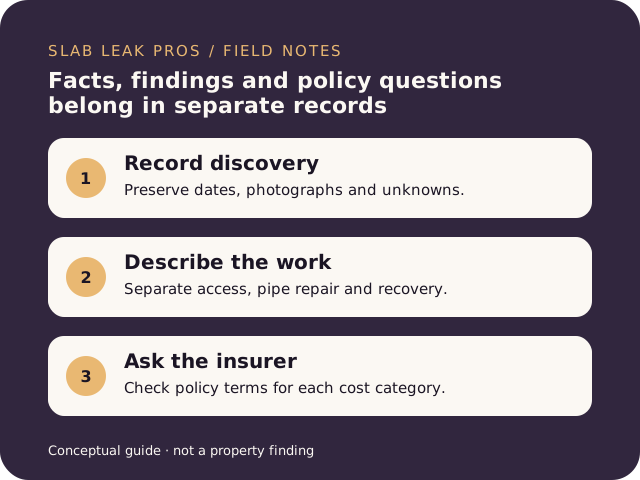
Separate the date of discovery from the unknown date a concealed leak began.
Record when you first saw or heard each symptom. That may include a damp area, an unusual bill, running-water sounds or a warm floor. Describe what you actually observed. If you do not know how long a hidden line leaked, say that the duration is unknown. Finding a problem suddenly does not establish that the damage developed suddenly.
Take wide photographs to show the room and closer images to show the condition, when safe. Preserve original files and dates. Our leak investigation guide explains why symptoms need testing before they become a plumbing diagnosis. Keep early observations even if later findings point somewhere else. A record that shows how the understanding changed is more useful than a timeline rewritten to fit an assumed cause.
How do you balance reporting with stopping further damage?
Do not allow an avoidable hazard to continue while waiting for paperwork.
The California Department of Insurance property claims guide recommends reporting the loss and taking safe temporary steps to prevent more damage. It also advises coordinating before extensive permanent repairs. Contact your insurer for instructions while arranging necessary stabilization. Never risk injury to create a photograph or preserve a damaged object.
Document the temporary measures and keep their receipts. Ask the insurer what inspection or evidence it needs before work advances, and record the response. Our spot repair scope page helps distinguish diagnosis, pipe access and the repair itself. If something must be opened promptly, ask for photographs and findings as work proceeds. An urgent repair and a careful record can often be planned together.
What belongs in the plumbing report?
The report should describe the investigation, including its limits.
Request the identified system and line, the tests performed, the relevant results and the location of the confirmed defect if known. Ask whether a stated cause is directly observed or only suspected. A report should not call a condition long-standing or sudden without a basis. If the test did not establish duration, that uncertainty should remain visible.
Save photographs of accessible damaged pipe and surrounding conditions when available. Coordinate retention or disposal of physical evidence with the insurer and the people doing the work. Do not keep sewage-contaminated materials inside simply to preserve proof. Our Granada Park repair planning guide discusses access and finishes; it makes no prediction about any home's construction or insurance outcome.
Why should the estimate separate different kinds of work?
One total can conceal questions the insurer needs to answer individually.
Ask for distinct descriptions of locating the leak, accessing the pipe, repairing or replacing it, drying affected materials and restoring finishes. Identify permit or inspection items where relevant. A reroute or wider replacement may have a different scope from repairing the confirmed failure. Clear itemization helps everyone see which task a question or decision concerns.
The Granada Park localized repair guide helps organize the access-to-restoration sequence. Keep approved changes with the original estimate instead of replacing the earlier version. If hidden conditions change the scope, document what was found and when. The insurer may evaluate parts of the work differently; an itemized estimate does not mean every item will be covered.
Which coverage assumptions should you avoid?
The phrase slab leak does not determine an insurance result.
CDI's homeowners insurance guide lists sudden accidental water damage as generally covered and identifies seepage, wear and tear, mold and other common exclusions. It also tells consumers to read policy exclusions and consider endorsements. These broad categories cannot settle a particular concealed-pipe claim.
Ask your insurer separately about failed piping, access, resulting property damage, drying and any temporary living costs. Request the policy language supporting its explanation, together with applicable deductibles, limits and exclusions. We do not promise that access is covered or that pipe replacement is always excluded. Our Placentia resource for documenting a defined repair explains the repair decision while leaving policy interpretation and claim decisions with the appropriate insurance professionals.
What should remain in your file after repairs?
Keep a record that can be understood without relying on memory.
Store the policy, claim number, photographs, reports, estimates, invoices and receipts together. Add a log of calls with dates, names and the topics discussed. Keep copies of written instructions and decisions. CDI recommends records of correspondence and evidence of damaged belongings. A room-by-room inventory can help separate contents losses from building work.
When the work changes, ask for a written explanation. If further damage is discovered, notify the insurer and document it rather than assuming the first estimate covered everything. Ask about unresolved questions through the insurer's stated process. Documentation supports a review; it is not a guarantee of reimbursement. Keep the completed repair record as well, including the final scope and any separate moisture or restoration findings, so the claim file reflects what was actually done.
Questions about this guide
Does my insurer cover every slab leak?
We cannot determine that from the leak label. The actual policy, cause, timing, exclusions, endorsements, limits and deductible affect the insurer’s evaluation.
Should we guess when the hidden leak started?
No. We recommend recording the discovery date and clearly marking any unknown duration. Observations and confirmed findings should be kept separate from assumptions.
Are photographs enough for a claim?
They are helpful, but we also recommend retaining reports, itemized estimates, receipts, correspondence and the insurer’s requested documentation. Requirements depend on the claim.
Must we delay urgent work until an adjuster visits?
We would coordinate promptly with the insurer while taking safe necessary steps to limit damage. Do not prolong an active hazard simply to wait for an inspection.