
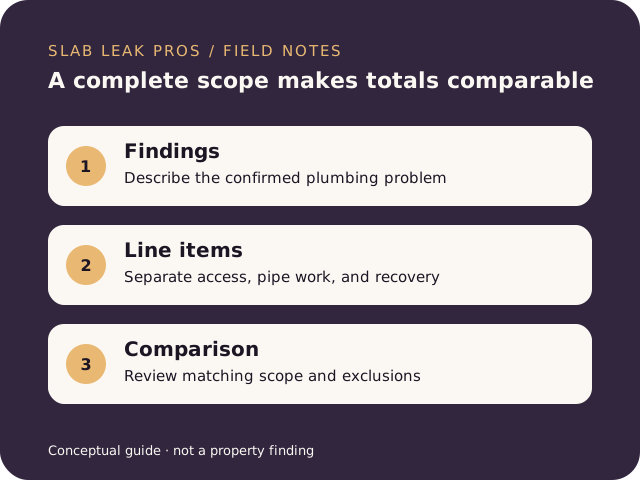
What must an estimate explain before its price is useful?
A total becomes meaningful when you know the confirmed problem and the work included.
Start with the findings behind the estimate. Does it identify a pressurized supply leak, a drain problem, or an unresolved source? An allowance for further investigation is different from a fixed scope for an already located failure. The paperwork should make that distinction clear.
Ask which fixture groups and pipe sections are covered. Replacing one defect, bypassing a branch, and renewing the dwelling supply are different projects. Their totals should not be compared as if each includes the same piping and the same remaining risks.
The California Contractors State License Board encourages comparing written bids on identical scope. That is the useful starting point for a repair decision. Verify the license for the actual work and ask what is excluded before deciding that one total offers a saving.
We outline the order of those decisions in our Placentia guide to evaluating a complete repair estimate. Keep source confirmation ahead of method selection so the price comparison describes an established task.
Which job components can change the total?
Break the project into diagnosis, access, repair, testing, and recovery.
| Component | Question for the estimate |
|---|---|
| Diagnosis | Which tests and findings are included before a method is selected? |
| Access | Which floors, walls, ceilings, or built-in features must be opened? |
| Piping | What length or fixture group is covered, and which material is proposed? |
| Completion checks | How are repair testing and required inspections handled? |
| Building recovery | Who handles drying, patching, and finish replacement? |
A diagnosis charge should describe its deliverable rather than promise that every concealed uncertainty will disappear. Ask whether it includes a written finding, what might require further access, and how any later testing is approved. Keep the test record with the repair estimate.
Access costs can change sharply with the affected room and finish. An opening near a built-in cabinet poses a different restoration task from one in an accessible garage area. Discuss the actual surface and route without assuming that a neighborhood name establishes the construction.
Our reroute planning explanation helps compare a new supply path with access at the failed location. A bypass may reduce one type of opening while requiring others, so “less floor work” is not the same as “no restoration.”
How can access permissions and permits affect the scope?
Confirm who can authorize the work and which local review applies to the chosen method.
For ordinary site-built residential plumbing, check the proposed work with City of Placentia Building and Safety. Do not assume a leak-related project is exempt from permits. Ask the bidder to state which approvals are included and who arranges them for the actual scope.
Connected buildings can add coordination tasks. A shared shutoff, a common surface, or access through another space may require permission. Establish those responsibilities early so the estimate does not quietly assume authority that the homeowner does not have.
Our Altura property-access guide explains why an ownership label does not settle pipe responsibility. The estimate should follow the relevant property documents and identified line, rather than treating every pipe near the unit as owner-maintained.
Site arrangements can also influence labor and scheduling. Discuss entry, staging, protection of nearby finishes, and restrictions that actually apply at the property. Do not accept a vague “local conditions” allowance without an explanation of which condition creates the added work.
What questions make competing bids easier to compare?
Use the same checklist for each proposal, including the items outside plumbing.
- What evidence supports the proposed repair limits?
- Which openings and protective measures are included?
- What remains in service, and which fixtures lose water during work?
- Who owns the drying and finish-restoration tasks?
- Which approvals, tests, and completion records are included?
- What conditions can change the total, and how are changes authorized?
Compare exclusions as carefully as included work. One bid may stop at a tested pipe, while another includes patching and floor replacement. Ask each bidder to clarify the same list of tasks before comparing totals, especially where a finish cannot simply be put back unchanged.
We use the Altura localized repair guide to show why opening permissions and repair boundaries belong together. A small pipe replacement can still require a careful access and restoration plan.
Record temporary work and later permanent work separately. In an urgent situation, ask what the immediate charge controls and what remains unresolved. There is no need to delay safe stabilization for a perfect comparison, but the later repair scope should still be documented.
Finally, ask how any payment schedule and offered workmanship terms relate to the written contract. We do not publish invented prices, promised insurance payments, or an assumed warranty. The decision should rest on the real proposal, verified qualifications, and the conditions of the property.
Questions about this guide
Why does one estimate include detection separately?
The source may need confirmation before the repair method can be defined. Ask what the diagnostic charge delivers and whether any part is credited toward later work. Do not assume an inspection price includes excavation, pipe replacement, or finish restoration unless the proposal says so.
Can I compare a spot repair quote with a whole-home repipe quote?
You can consider both approaches, but they cover different amounts of piping. Compare why each is recommended, which fixtures it serves, and what remains unchanged. A wider scope needs a documented reason; a lower total for less work is not a like-for-like bid.
Will my insurer cover all of these cost components?
The estimate alone cannot answer that. The policy and the facts of the loss control the insurer’s review. Ask the insurer about the separate components and keep itemized findings, photographs, and receipts. Do not assume a coverage decision from a method name or a contractor’s total.
Is there one typical repair price for every Placentia neighborhood?
A neighborhood name does not define leak location, pipe coverage, access, or finishes. Those property-specific details shape the work. We explain the cost drivers rather than publishing a made-up local range that could be mistaken for a quote.