
Are both proposals solving the same plumbing problem?
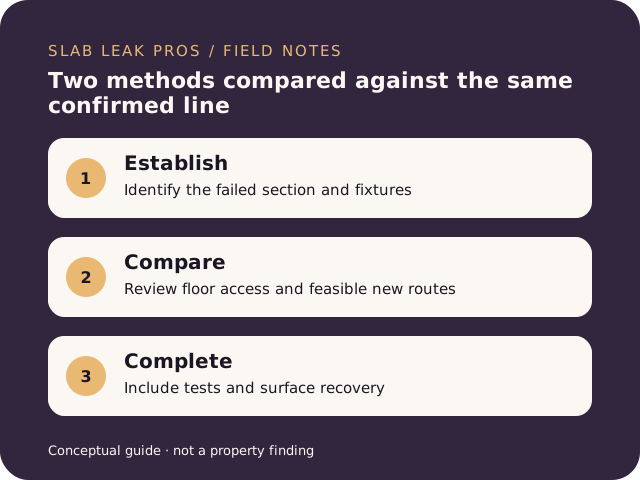
Compare the affected line and fixture coverage before comparing the names of the methods.
A spot proposal should identify the damaged section and the access needed to reach it. It should also say how the replacement connects to the remaining pipe. Without that boundary, “small repair” can leave important questions about nearby conditions and finish work unanswered.
A reroute proposal should identify the line being replaced, its new starting point, and every fixture it must serve. The old path must be addressed in the written scope. Replacing one branch is different from repiping the whole home, even if the new pipe runs through several rooms.
Read both proposals beside the findings. If one addresses only the confirmed failure and another replaces a larger branch, the prices describe different work. Ask why that broader coverage is recommended and what evidence supports retaining or replacing the rest.
Our Placentia decision guide for spot repairs and bypasses provides the larger repair framework. Use it to keep diagnosis, method selection, and building recovery in a sensible order instead of choosing from a method label alone.
When can a targeted spot repair be a reasonable choice?
The case for localized work depends on a defined failure, suitable connections, and acceptable access.
A clearly located defect may allow a contained replacement where the surrounding conditions support it. That judgment needs more than a surface stain. Ask what the investigation found about the affected section and what is still unknown about concealed piping beyond it.
Access can be the deciding issue. A pipe below an accessible floor is different from one below a built-in feature or a difficult finish. The slab itself may also require specialized assessment. A post-tension slab contains tensioned steel cables; access must be planned by appropriate professionals before cutting.
Our spot repair method guide separates pipe replacement from opening and restoration. Request an explanation of who handles each task, what surfaces are included, and what happens if the actual opening must change after work begins.
- Which test findings support this location and repair limit?
- How will access hazards be assessed before an opening?
- Which pipe remains on either side of the replacement?
- What is included in the slab patch and floor finish scope?
- How will the repaired line be tested before the opening is closed?
A localized repair is not a promise that another section will never fail. It is a defined response to the problem and conditions documented now. Ask for any offered workmanship terms in writing without assuming that a particular warranty exists.
What makes a reroute practical for this home?
A usable new path must reach the right fixtures while meeting installation and access requirements.
A reroute may avoid opening the floor at the failed section by carrying water through another route. It can still require wall, ceiling, garage, or cabinet access. Ask to see the intended path described in terms of actual rooms rather than a broad promise of “no demolition.”
The proposed pipe and fittings must suit the application and follow applicable code and manufacturer instructions. Support, protection, connections, and test requirements belong in the installation plan. Choosing a route is professional work, not a reason for a homeowner to improvise a concealed supply line.
For a local example of the planning questions, our Granada Park reroute guide asks how a replacement path affects floor access and finished surfaces. It does not assume that every home in the community has the same pipe layout or slab system.
Check that the proposed route serves all intended fixtures and leaves no accidental gap in coverage. Discuss how the unused section is handled and what records identify the final route. A clear drawing or written room list can help with later maintenance, provided it reflects the work actually completed.
How can you compare the complete disruption and recovery?
Look beyond the pipe line item to the work needed to return the home to use.
| Decision | What to compare |
|---|---|
| Coverage | Failed section, full branch, or a wider replacement. |
| Openings | Floors, walls, ceilings, cabinets, and access protections. |
| Service interruption | Which fixtures are affected and how the sequence is managed. |
| Completion | Testing, required inspection, patching, and finish restoration. |
Ask which findings could change the recommendation after access begins. A written change process helps keep a concealed condition from turning into an unexplained price or scope expansion. It should describe what needs your approval before additional work proceeds.
Our Granada Park service overview also highlights entry planning and surface recovery. Confirm access arrangements for the particular property rather than assuming a gate, association, or repair payment rule applies automatically.
Choose the proposal whose documented reasoning fits the line condition, access limits, and intended coverage. If those points are unresolved, request clarification before treating one total as better value. No method label can make up for an unclear repair boundary.
Questions about this guide
Is a reroute always less expensive than a spot repair?
There is no universal price order. A short accessible opening and a long replacement route involve different labor and restoration. Compare written proposals for the same confirmed problem, including access, testing, permits where required, and the work needed to restore the affected rooms.
Can a spot repair become a larger project after opening the floor?
Access can reveal conditions that were not visible during the initial investigation. Ask how those findings will be documented and how additional work would be approved. A change should explain the new evidence and revised scope rather than simply relying on the fact that the floor is already open.
Does bypassing a leaking branch replace all the water pipes?
Not necessarily. A branch reroute may cover only a defined group of fixtures. Whole house repiping is a broader supply replacement. Request a fixture list and route description so the coverage is explicit and the remaining piping is identified.
Should I select a method before leak detection?
You can learn the options beforehand, but the final choice should follow findings about the affected system and location. Otherwise, the selected method may solve a problem that has not been established. Ask which evidence would support each proposed approach.