
What was happening before the floor felt warm?
A useful temperature note includes the room conditions and the timing.
Start with ordinary sources of heat. Did sunlight reach that tile? Was a nearby heating system running? Had someone just used hot water? A surface that warms during an expected activity and cools afterward gives a different history from a new patch that remains noticeable between uses.
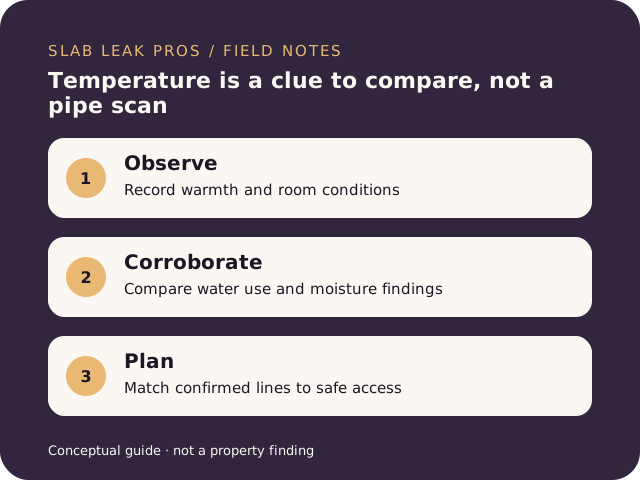
Record when the warmth was noticed and whether the room conditions changed. Avoid assigning a precise temperature with your hand. A simple description such as “the same spot felt warmer than the surrounding floor after several quiet hours” is more honest than an estimated reading.
Floor coverings also affect what people notice. A temperature difference may feel different through tile, wood, carpet, or a rug. That does not establish which assembly is present under the finish or whether the concealed pipe runs directly beneath the spot.
We connect the temperature question with repair choices in our Placentia resource for evaluating a warm-floor concern. Keep possible causes open until the investigation explains the water system and the source of the heat.
Which observations make hot-side leakage more plausible?
Temperature becomes more useful when the same timeline includes unexplained supply use or moisture.
A persistent warm patch together with unexplained meter use can support closer examination of the hot-water system. Add whether hot-water availability changed or a water sound continued with fixtures idle. Each observation still needs its own alternative explanations considered.
Do not turn the water heater into a homeowner test station. Leave covers, wiring, gas controls, and unfamiliar valves alone. A heater problem can change hot-water performance without a floor leak, and working on the equipment adds risks unrelated to documenting a surface clue.
- Describe the size and position of the warm area without marking it as the pipe location.
- Note recent hot-water use and nearby heat sources.
- Include any safe meter observation and its interruptions.
- Photograph visible floor changes without removing finishes.
- Say whether the concern affects a ground floor or an upper level.
Our hot-water slab leak explanation discusses how confirmed hot-side findings lead to repair planning. A bypass, which routes water through a new path, needs more information than surface warmth to define its endpoints.
What can a thermal camera show beneath the floor?
It shows temperature differences at the observed surface; it does not see a pipe through concrete.
Thermal cameras can make a temperature pattern easier to compare and document. FLIR explains that these cameras detect temperature differences, not moisture itself. A warm or cool shape can guide further checks, but its color is not a direct picture of liquid water.
Ask how the image was compared with normal conditions in that room. Sun exposure, building materials, heating equipment, and recent water use can influence the pattern. The interpretation should explain what additional findings support leakage and which explanations remain possible.
| Finding | What it contributes |
|---|---|
| A warm surface | A location and time for comparing a heat pattern. |
| Evidence of moisture | A reason to investigate where water came from and where it traveled. |
| A confirmed leaking line | A defined plumbing problem that can support a repair scope. |
Our Hamptons on the Green hot-line guide applies this distinction to fixture grouping and access. The route supplying the affected rooms must be established rather than drawn from the outline of the warm area.
How do room layout and active damage change the next step?
The practical response depends on safety, the affected spaces, and the confirmed system.
If dampness is spreading or there is a concern about electricity, avoid the affected space and arrange real assistance. Do not finish a heat log while an urgent condition develops. A fictional demonstration number is not a service line and cannot send help.
Where observation is safe, prepare a short room-by-room account. Identify which fixtures use hot water and which rooms have recent changes. This helps discuss the reach of a line without assuming all fixtures belong to one branch or that every floor in the home has the same construction.
Our Hamptons on the Green repair overview focuses on documenting routes and finish recovery. Ask how a proposed new pipe path reaches its fixtures, where access would be needed, and which wall or floor repairs are included.
Once plumbing work ends, any damp building materials need their own follow-up. A cooler surface is not proof that a floor assembly is dry. Discuss moisture assessment and finish restoration separately from the test confirming that the repaired supply holds as intended.
Questions about this guide
Can a hot supply pipe warm a floor without leaking?
Normal hot-water use can affect nearby surface temperatures. Whether that explains a particular patch depends on the route and the timing. A lasting or new change should be evaluated alongside water-use information and other findings rather than being dismissed or labeled a leak on touch alone.
Does the hottest point show exactly where the pipe failed?
No. Heat can spread through materials, and other sources can shape the surface pattern. The hottest visible point is not automatically the location for access. Ask what line-tracing or testing evidence supports the proposed opening and how slab hazards will be addressed.
Should I remove a rug or floor finish to inspect the warm area?
Do not pull up installed finishes or open the floor as a diagnostic experiment. Describe the covering and record visible changes from a safe position. Ask the inspector whether access is needed and how it would be planned before disturbing the assembly.
If the warmth disappears, is the problem resolved?
A changing temperature can reflect altered use, weather, or heat flow. It does not by itself prove that a suspected leak has stopped. Keep the original timeline and report the change, especially if unexplained water use or dampness remains.