
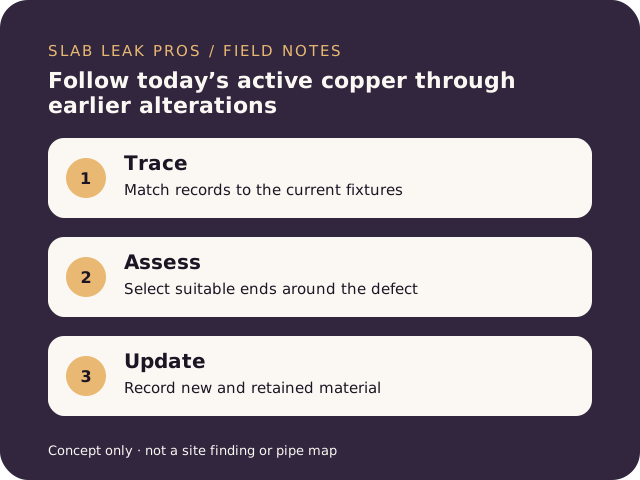
What does the copper finding tell you about the present line?
The existing system may differ from the layout shown on an old invoice or remembered from a remodel.
Copper pinhole leak repair in Atwood, Placentia, CA repairs a small opening through confirmed copper tubing. A leaking joint or a wet transition between materials is not automatically the same finding. Establish the escape point and identify the active branch before choosing a repair method.
Atwood is an older small-lot residential area in city records, but its exact housing eras and current foundations are not established uniformly. An older setting does not show whether the relevant tube is original, replaced, rerouted, or still connected to the fixtures first listed in earlier paperwork.
Our guide to evaluating copper-wall damage explains the repair fundamentals. For an altered home, also ask how the inspected segment connects to both the current fixtures and any later replacement material. Treat the actual line as the authority, with older records supplying context.
Which earlier changes should you bring to the assessment?
A dated record can distinguish repeated material failure from unrelated repairs in the same room.
Gather invoices that describe locations, supply type, and the extent of previous replacement. A statement that “the kitchen was repiped” may omit the source connection or a retained branch. Ask which parts of that description can be matched to the piping in service now.
- List past copper defects separately from fixture and appliance leaks.
- Identify any known new-to-old connection near the present moisture.
- Keep safe photographs of exposed work before finishes were closed.
- Note rooms added or changed without guessing how their piping was routed.
- Mark inaccessible sections as unknown rather than sound or defective.
Do not remove insulation, scrape copper, or disturb a connection to improve the evidence. A fine spray can be hazardous near power, and a tube’s color cannot establish its cause of failure. The history should guide questions without becoming a claim that city water damaged every retained section.
How should replacement limits account for earlier alterations?
A repair should reconnect to suitable material while explaining the altered branch that remains.
- Trace the active coverage. Identify the fixtures served by the leaking section and any relevant earlier bypass.
- Confirm the defect type. Separate tube-wall perforation from joint or transition leakage.
- Assess both replacement ends. Review accessible retained material and the proposed connection method.
- Set an authorized scope. Explain what would require added length, another opening, or a revised route.
- Test and document. Keep final material and coverage records with the relevant checks.
If the confirmed section is buried, our Atwood direct-access guide adds the floor and concrete questions. The tiny size of a perforation does not identify a safe cutting location or the extent of suitable surrounding tube.
Arrange professional assessment of the actual slab and concealed features before any opening. A homeowner can prepare a room list and safe access information without attempting soldering, pressure tests, or an external patch as a permanent repair.
What makes the complete Atwood job larger than the hole?
Staging, access, and retained connections can matter more than the apparent size of the damaged point.
At a small-lot property, clarify where equipment and removed material can be placed without blocking required routes. Do not assume that a neighboring space is available for access. The estimate should reflect the route that can actually be used and the surfaces needing protection.
Ask for separate descriptions of source work, openings, replacement piping, verification, and finishes. If exposed material requires a broader replacement, request the evidence and revised approval before additional permanent work. Specialized cause review should not be silently included in a claim that an ordinary local repair explains all corrosion.
Where failures across the dwelling are documented, compare Atwood whole-house supply renewal. Its coverage must account for newer sections already present. Confirm covered permit work with City of Placentia Building and Safety rather than assuming that a small defect or earlier permit settles today’s requirements.
Which local facts help prepare the property discussion?
Known neighborhood context helps with questions; it does not replace a present-system inspection.
| County | Orange County, CA. |
|---|---|
| Permit authority | City of Placentia Building and Safety for the relevant ordinary residential plumbing scope. |
| Water service | Confirm the supplier and meter at the address from current account information. |
| ZIP check | 92870 is supported in neighborhood records; verify the full property address. |
| Housing context | Older small-lot single-family housing; exact era, foundation, and current supply material need property-level confirmation. |
Our Atwood repair-method overview relates those work-space questions to the broader options. It does not infer pipe condition from lot size or the age of the surrounding neighborhood.
What should the completion record preserve for the next repair?
The final description should make the current arrangement clearer than it was before the work.
Before agreeing to the repair, ask where its two ends will be, which material remains, and how any old route is addressed. Identify the fixtures served after completion. Clarify the approval process if an unexpected connection changes the planned extent.
Keep photographs or a written room reference that identifies the new section without implying that all concealed piping was viewed. Include relevant tests and required review. Describe remaining moisture, patches, or finish work as unfinished tasks with their own next steps.
Our Placentia guide to copper repairs after earlier pipe alterations supports that record-first approach. A later pinhole can then be compared with a real map of retained and replaced material instead of an uncertain count of past visits.
Copper Pinhole Leak Repair questions in Atwood
Atwood questions address remodel records, material transitions, staging, and approved scope changes.
Does a past Atwood remodel show that all copper was removed?
Not by itself. The record may describe only particular rooms or a branch. Compare earlier paperwork with the active system and identify retained sections. Do not label all concealed pipe new or old from a project name alone.
Is moisture at a material transition a copper pinhole?
A transition can leak at the connection, while a pinhole passes through the tube wall. Water can also track from another point. The repair should name the observed defect rather than use pinhole as a general label for all nearby wetness.
Can a small lot prove the copper is hard to access?
No. It makes staging worth discussing, but the actual tube may be exposed or concealed. Inspect the work route and connection points. Keep site arrangements separate from the material-condition decision.
How should a changed repair length be approved?
Ask for the newly observed condition, the revised replacement limits, and any added access or finish work in writing. The agreed change should identify why the original boundary no longer fits. Retain that explanation with the final verification record.