
What should slab leak detection establish at Northpoint at Alta Vista?
Identify the affected supply branch before using floor level or garage access to suggest a repair route.
Slab leak detection in Northpoint at Alta Vista, Placentia, CA investigates a concealed supply loss and the evidence for its location. It should distinguish the line serving affected fixtures from the room where symptoms appear. Water at one level does not prove that a pipe beneath that level has failed.
Documented Northpoint at Alta Vista examples include 1980s single-family homes with one- and two-story layouts. That mix makes a fixture-and-level record useful. The building date does not establish the present pipe material, and a second floor does not reveal how a buried branch reaches its fixtures.
Garages can offer accessible controls or possible connections in some homes, but the inspection must establish their relevance. A garage wall should not become the assumed source simply because it is easier to open than a finished room. Ask how the symptoms, branch tests, and location findings fit together.
We set out the instruments in our Placentia guide to leak-location testing. For Northpoint, the practical result is an identified line, a supported search area, and a clear explanation of what additional access would help decide the repair.
Which signs help the inspection follow the actual system?
Use ordinary observations to show how symptoms relate across the garage, ground floor, and any upper rooms.
List the fixture nearest the first moisture and other fixtures with changed performance. Include the level of each room. A stain below a bathroom may need a fixture or drain assessment, while persistent unexplained flow may support a pressurized-line investigation.
If one floor area feels warm, note recent hot-water use and whether the pattern persists between uses. Keep the observation separate from a diagnosis. Surface heat can help direct testing, but thermal imaging does not reveal a pipe hole through concrete or show the entire concealed route.
Record any continuing water sound without entering a wet or unsafe area. Sound can travel through materials, so the loudest room is not automatically the source. The relevant branch must be identified before listening evidence can support a useful repair location.
- Unexplained use after known fixture and outdoor demand are considered.
- Moisture recurring near the same room transition or wall.
- Affected fixtures on more than one floor.
- Earlier repairs linking a garage connection to an interior room.
- Recent fixture or appliance changes that could explain a new symptom.
How does detection work across different floor levels?
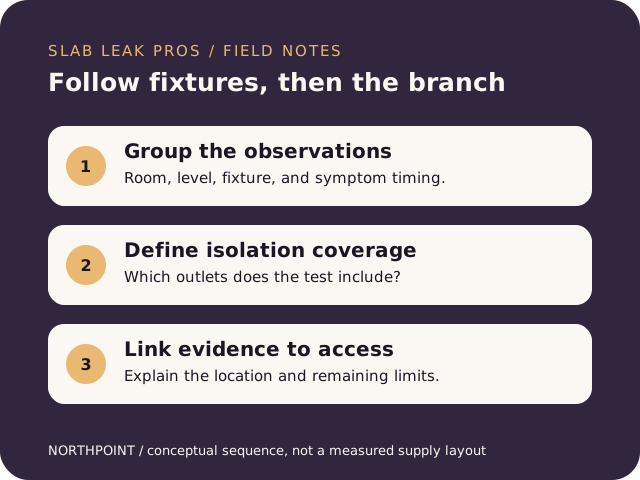
The test plan should define the system without treating the house layout as a pipe diagram.
- Review the fixture record. Identify levels, symptom timing, and earlier pipe work.
- Check accessible controls. Establish what each proposed isolation actually serves.
- Confirm the supply concern. Use suitable branch tests and consider separate systems when indicated.
- Narrow the location. Compare acoustic evidence and relevant surface observations under the observed conditions.
- Explain the repair boundary. State the affected branch, supported location, and unresolved route questions.
A pressure or isolation result concerns its defined section. If an upstairs fixture remains connected outside that boundary, the result cannot describe its whole supply. Ask for plain language about which fixtures are included so later repair proposals cover the same problem.
Have safe access to visible garage controls and the rooms being assessed. Do not move a heavy appliance, remove wall finishes, or operate an unfamiliar valve to prepare. If the inspection needs additional access, agree on that step and its authorization before it is performed.
What changes the amount of detection work?
A multi-level symptom does not require a larger repair by itself, but it may require a clearer test boundary.
| Fixture grouping | Which outlets and floor levels share the tested section? |
|---|---|
| Testing access | Are relevant garage connections and controls accessible and authorized? |
| Location conditions | How do noise, finish layers, and unavailable spaces limit the readings? |
| Further assessment | What approves another test, an opening, or a replacement-route evaluation? |
Northpoint has documented association context; confirm current requirements for any affected exterior surface or route. Covered plumbing repairs also need scope-specific permit confirmation with Placentia Building and Safety. Detection findings should not be presented as approval for a new exterior pipe path or a concrete opening.
Which local records help keep the inspection specific?
Resolve utility and property questions using the service address and current documents.
| County | Orange County, California. |
|---|---|
| Plumbing permits | City of Placentia Building and Safety for ordinary site-built residential work; confirm covered repair requirements. |
| Water supplier | Verify the actual utility on the current bill or by an address-based lookup. |
| ZIP | 92870 appears in property records; verify the exact service location. |
| Documented layouts | One- and two-story single-family examples from the 1980s with association context. The current slab and piping are property-specific. |
What should be clear before the next repair decision?
Keep the fixture coverage and location evidence together so proposals can address the same line.
Before testing, ask what would confirm the suspected branch and whether the appointment includes only location work. Find out how additional access or inconclusive results will be handled. Keep a list of the fixtures that must remain usable if part of the system is temporarily isolated.
Afterward, request the test boundary, evidence for the marked area, and any limits from noise or unavailable rooms. Confirm the status of operated controls and temporary water restrictions. If service has been restored, check the ordinary affected fixtures without trying to conduct a pressure test yourself.
When the finding supports a hot-side problem, the Northpoint hot-water repair guide considers the affected fixture group. A reroute at Northpoint at Alta Vista also needs an assessed replacement path, with access to suitable connections and a clear list of finishes affected.
Use the Northpoint repair overview to compare the wider scopes. We explain the complete sequence in our Placentia guide to matching findings with pipe repairs, including verification before access is closed.
Which local guides add useful testing questions?
These pages provide other access contexts without defining the piping in a Northpoint home.
Slab Leak Detection questions in Northpoint at Alta Vista
Northpoint questions focus on multi-level coverage, garage connections, thermal clues, and using findings in a reroute proposal.
Does a two-story Northpoint home need testing on both floors?
The inspection should cover the suspected system and relevant symptoms. Describe affected fixtures on each level so the test boundary is clear. The floor count alone does not determine which branches need assessment.
Can a garage connection identify the buried route?
It may provide a useful testing or connection point if the active system supports it. It does not reveal the complete route by itself. Northpoint detection should connect that point with branch evidence rather than assume the path.
Will a hot floor tell us which bathroom is served?
Surface warmth does not identify every connected fixture. Suitable isolation and system assessment must establish fixture coverage. Keep the thermal observation as one clue alongside the branch findings.
What should a Northpoint reroute proposal use from detection?
It should address the identified failing section and explain which fixtures the replacement will serve. The new path, access, connections, and surface restoration still need assessment. Detection alone does not establish that a proposed route is suitable or approved.