
Which water-use changes deserve a closer look?
Start with the supply record, then check what was happening in the home when it changed.
- A bill rises without an obvious change in use. Compare billing dates and meter readings, not just the amount due. Longer billing periods, changed rates, irrigation, and visiting family can change the bill without a buried leak.
- The meter records use during a planned quiet period. Automatic equipment and shared plumbing can explain that movement. Write down the start and end readings before deciding what they mean.
- Water can be heard when fixtures appear idle. A steady hiss or flow sound is useful to describe. Appliances, toilets, and nearby units can also make water sounds.
These three clues are stronger together than alone. A higher bill plus repeated unexplained meter use gives a clear reason to investigate the supply system. It still does not identify the failed branch, the depth of a pipe, or the place where flooring should be opened.
We organize the wider sequence in our Placentia overview for interpreting early leak clues. Use that guide to move from observations to a repair decision without treating a symptom list as an inspection result.
What can floors and nearby rooms tell you?
Describe what you see and feel, while leaving the cause open until it is checked.
- A warm patch stays noticeable. Hot supply leakage is one possible cause. Sunlight, heating equipment, and normal pipe use can also warm a surface.
- Flooring changes shape or separates. Lifting, gaps, or soft areas can point to moisture or another floor problem. Avoid lifting finishes simply to look underneath.
- Dampness returns after the surface is dried. Record the spot and the conditions. Water can travel from a wall, appliance, window, or drain before appearing on the floor.
- A musty odor develops in one room. Odor alone cannot identify hidden growth or its source. A moisture assessment may be needed even when the pipe location is still unknown.
Photograph the same spot from the same position so later changes are easier to compare. Include a nearby fixed feature for context. Keep the first discovery date separate from guesses about when the leak began; discovering water today does not prove that it started today.
An upstairs wet floor needs a broader source search. Our Cinnamon Tree slab leak planning guide explains why the affected level and access authority matter in connected buildings. A community name never replaces an examination of the actual unit.
Which additional changes belong in your notes?
The last three signs help describe the affected system, but each has ordinary alternative explanations.
- Hot water seems harder to maintain. A hot-side loss may add demand, but heater settings, appliance use, or equipment faults can also affect comfort. Do not adjust or dismantle a heater as a leak test.
- Water flow at fixtures changes. A new weak shower or uneven faucet flow deserves a description. Supply conditions, fixture restrictions, and other faults can produce similar effects.
- A crack or stain changes near a damp area. Keep a dated photograph and describe the change. Neither a crack nor a slab leak alone establishes structural damage.
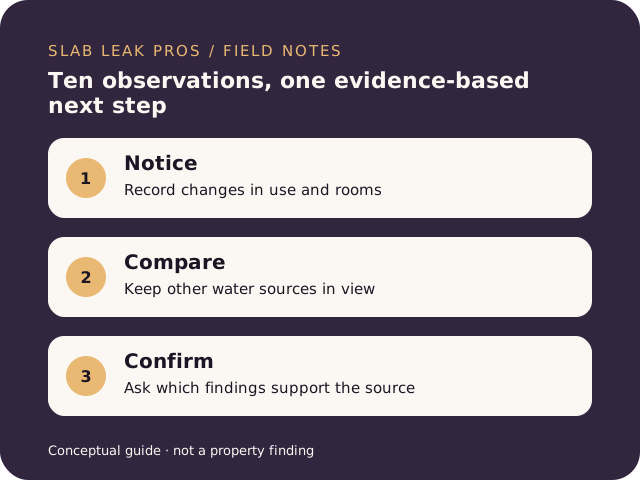
Separate direct observations from conclusions in your notes. Write “bathroom floor felt warm at breakfast and again that evening” rather than “the hot pipe broke here.” This distinction helps the inspection begin with useful evidence instead of a location that has already been assumed.
We describe confirmation methods and their limits in our slab leak detection explanation. Testing should answer which system is losing water and what the findings support before a repair opening is selected.
How should you respond to several warning signs?
Choose a safe next action based on active damage and access, not on how many boxes the home checks.
Keep people away from water near electrical equipment or an unstable surface. Do not walk into an affected space to get a better photograph. If there is an immediate threat to people, use real emergency assistance; our displayed demonstration number cannot receive a call or request help.
When conditions are safe, gather the bill, photographs, and a short timeline. Include whether symptoms follow a shower, laundry cycle, irrigation run, or a period with no intended use. These details can guide the testing order without giving a homeowner the risky job of opening piping.
For connected homes, our Cinnamon Tree detection questions focus on meter boundaries, neighboring spaces, and authorized access. Do not shut down shared service or enter another unit without the right coordination.
After the source is confirmed, discuss pipe repair and building recovery as separate tasks. Stopping water loss does not by itself dry a floor assembly or establish that a changed crack is harmless. Request the appropriate follow-up assessment for the problem actually found.
Questions about this guide
Does one warm tile mean I have a slab leak?
One warm tile is a reason to observe the pattern, not a diagnosis. Note sunlight, recent hot-water use, and whether the warmth persists. A professional can compare the temperature clue with moisture and supply-system findings before deciding whether hidden leakage is involved.
Can a toilet cause the same high bill as a hidden pipe leak?
A running or leaking toilet can contribute to unexplained metered use. That is why accessible fixture checks belong before a buried-pipe conclusion. If water use remains unexplained, describe which fixtures were checked and what was observed rather than assuming the remaining loss is under the slab.
Should I wait for all ten signs before asking for an inspection?
No. Active damage or repeated unexplained water use can warrant help without a complete symptom list. Some leaks give few visible clues. The point of the list is to improve the description of a concern, not to set a waiting period.
Does a new floor crack prove the leak damaged the foundation?
A crack can have several causes, and a plumbing symptom list cannot assess structural condition. Document an apparent change from a safe location. Ask whether a qualified structural assessment is needed, especially when movement or unsafe conditions are suspected.