
Does this meter measure only your home?
The test starts with understanding what the reading includes.
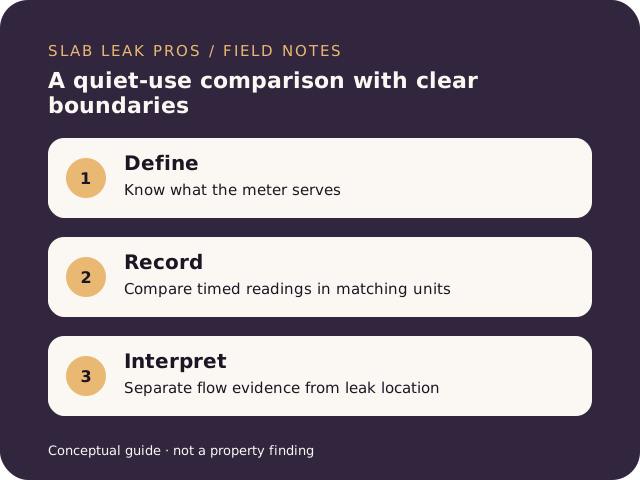
Check whether the meter serves your dwelling alone or also supplies another unit, common area, or landscape system. If that boundary is unknown, ask the utility or building manager. A quiet apartment can still share a meter with active water use elsewhere, making a personal no-use comparison misleading.
Use your bill to identify the water supplier for the actual address. We do not assign a supplier from the name of a Placentia neighborhood. Look for the meter number or account instructions without posting a complete account number in photographs or public messages.
Only observe a meter that is safely accessible. Do not remove utility seals, reach into an unsafe box, or open equipment that is locked or unfamiliar. Skip the check when traffic, animals, standing water, heavy covers, or any other access concern makes observation unsafe.
Our Woodfield water-loss planning page uses connected-home access questions to explain why permission and the actual service boundary come first. The same care applies whenever another household could be affected.
How can you arrange a meaningful no-use period?
Choose a period when intentional water use can stop without disrupting a shared service.
EPA WaterSense describes comparing meter readings before and after two hours with no water use. Plan that window with everyone whose use reaches the meter. A toilet refill or a short faucet use counts, even when it happens in a room far from the concern.
Remember automatic uses: irrigation, a scheduled appliance cycle, ice-making equipment, and other devices connected to the supply. Check the household schedule through normal, safe controls. Do not disconnect plumbing or change unfamiliar equipment merely to complete the observation.
- Write down who needs to avoid using fixtures during the window.
- Check whether watering or appliances are expected to run.
- Choose a time when the meter can be read safely at both ends.
- Leave shared shutoffs and utility controls alone.
- Note anything that interrupts the planned quiet period.
If the home cannot reasonably stay quiet for that period, record the limitation. A shorter or interrupted comparison may still give an inspector context, but it should not be presented as the same controlled observation. Never postpone urgent help just to finish a two-hour interval.
What should you write down at the meter?
A clear record is more useful than an estimated impression that something moved.
Record the first reading, date, and time exactly as displayed. If a photo is safe and permitted, include enough of the face to show the reading and unit labels. Digital displays and dial layouts differ, so ask the utility about a display you cannot interpret.
After the no-use period, record the second reading and time using the same units. Do not compare a volume number from one screen with a flow-rate number from another. Keep the original images so a later review can distinguish a reading error from a real change.
| Record | Why it matters |
|---|---|
| Start and end times | Shows the length of the actual quiet window. |
| Readings and displayed units | Makes a later comparison possible without guessing. |
| Known use or interruptions | Identifies another explanation for measured flow. |
| Meter coverage | Shows which rooms, units, or systems were included. |
We set out the next questions in our guide to confirming a hidden supply leak. A meter note is a starting record for that work; it is not a location mark for cutting a floor.
What does a changed reading actually establish?
Keep the conclusion as narrow as the observation.
If the readings differ, water passed through that meter during the interval. Before suspecting concealed piping, review the known uses and accessible fixtures. Irrigation or a toilet can account for flow that a household did not notice. A change does not tell you the material, location, or condition of a buried pipe.
If the readings do not change, no flow was recorded at the display resolution during that window. This does not rule out intermittent leakage, losses outside the meter boundary, or a wastewater leak. A wet area that appears after a shower still deserves attention even when a supply-meter comparison is quiet.
Our Woodfield diagnostic planning questions show how a reading fits with line tracing and access limits. Give the inspector both the observation and its limitations rather than requesting a particular repair based on the meter alone.
For the broader choices after a source is found, return to our Placentia guide from meter observations to repair choices. The repair discussion should follow confirmation, with affected fixtures and access explained in writing.
Questions about this guide
Do I need to turn off the house water for this comparison?
The basic no-use comparison observes the meter while the household avoids water use. It is not a shutoff or pressure test. Leave unfamiliar or shared controls alone. An inspector or utility can explain whether a different, authorized procedure is appropriate for a particular system.
What if someone flushes a toilet during the two hours?
Record the interruption rather than hiding it. The meter may simply be recording that refill. If conditions allow, plan a new quiet window. Do not label an interrupted comparison evidence of hidden leakage without accounting for the known water use.
Can I calculate a monthly loss from one meter observation?
A brief observation may not represent a whole month because flow and household conditions can change. Preserve the raw readings and time interval instead of turning them into a precise prediction. Ask the utility or inspector how the meter information should be interpreted.
Does a still meter mean the damp floor is safe to ignore?
No. A still reading only describes metered flow during the observed period. Drainage, appliance discharge, outside water, and intermittent faults can cause dampness without that result changing. Keep investigating a recurring wet area and seek help promptly when damage or safety concerns are present.