
Why does slab leak detection matter in Atwood?
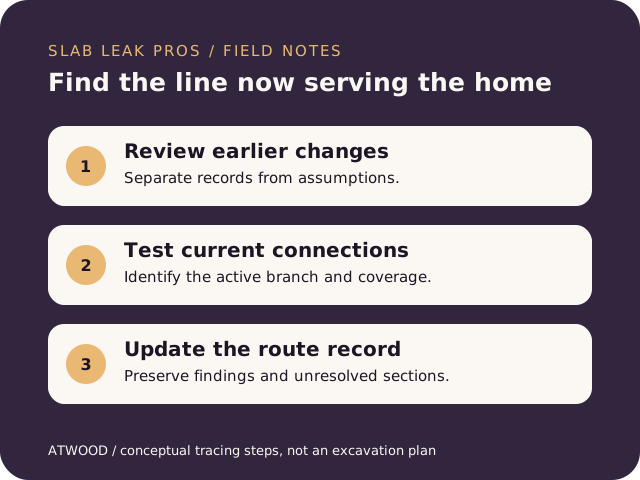
Testing should follow the current supply rather than an assumed original layout.
Slab leak detection in Atwood, Placentia, CA checks a suspected concealed supply loss and develops evidence for its location. It should explain which active line is involved. A prior patch, older room, or nearby shutoff does not prove that the leaking water follows the original route.
City planning information identifies Atwood with older, small-lot single-family housing. That context makes earlier alterations worth discussing, but it does not establish a uniform age or foundation. A home may have changed fixtures, added connections, or earlier repairs that matter more to detection than its general neighborhood description.
Bring records of work near the affected rooms, even if they are incomplete. A sketch or photo showing an abandoned line can help distinguish it from active supply. The inspector should verify the current connections rather than treat an old repair location as the new failure point.
Our Placentia slab leak testing guide explains the main methods. In Atwood, ask how the inspection accounts for changed routes and identifies a branch that can be repaired without confusing retained piping with an unused buried section.
Which signs are useful when the pipe route has changed?
Describe what is happening now and how it relates to earlier work.
Record the first new moisture, including its room and date. Note whether it is near a known access patch, appliance, or added fixture. A repeated symptom near an old repair can justify investigation, but it does not prove the same connection has failed again.
Unexplained water use may support a pressurized-supply check after ordinary indoor and outdoor demand are considered. Describe what the observed meter serves and which uses were known to be off. A meter result cannot locate a pipe defect or reveal every later branch alteration.
If you notice a continuing water sound, identify accessible listening locations without entering wet areas. Sound can travel along materials and pipe paths. The inspector should connect that evidence with a tested line instead of selecting access from noise alone.
- Warm floor after normal use: report timing and the affected fixture group.
- Moisture at an addition or altered room: bring any available connection records.
- Changed flow at one outlet: identify which other outlets still behave normally.
- Recurring outdoor-edge wetting: note irrigation and other possible sources for separate checks.
- Unclear old pipe work: distinguish what you know from what earlier paperwork only suggests.
How should an Atwood detection visit proceed?
A controlled sequence makes the findings useful even when records are incomplete.
- Review current symptoms and prior changes. Identify fixtures, additions, and known abandoned piping.
- Confirm accessible controls. Establish which active sections can be isolated with authorization.
- Test the suspected branch. Use suitable methods to assess the loss within a defined boundary.
- Compare location clues. Interpret listening and relevant surface readings alongside the branch result.
- Record active and uncertain routes. State what is supported and what needs further tracing.
Plan where equipment can be placed while keeping the home's normal entry route clear. Small-lot context does not justify assuming that a side path, neighboring space, or exterior connection is available. Confirm the actual access rather than relying on a convenient-looking route.
Do not dig for an old pipe, break a patch, or disconnect a suspected abandoned line to help the visit. It may still serve a fixture or conceal other features. Any later opening needs a suitable plan based on the actual slab or ground conditions, not the detection mark alone.
What affects the inspection scope and later approvals?
The work should define how unknown alterations or restricted testing points will be handled.
| Earlier pipe work | Records that help distinguish active connections from abandoned sections. |
|---|---|
| Isolation access | Available authorized controls and the fixtures included by each test. |
| Work path | Safe room access and equipment placement without obstructing entry. |
| Added investigation | How further tracing, an opening, or a return visit will be approved and recorded. |
Ask what finding the inspection price covers and which unresolved condition could change the work. For covered repair, confirm the applicable permit requirements with Placentia Building and Safety. A previous alteration or an old permit does not establish approval for the newly proposed scope.
Which local details should be verified before testing?
Current account and property records are more useful than assumptions about the age of every home.
| County | Orange County, California. |
|---|---|
| Plumbing permits | City of Placentia Building and Safety for ordinary site-built residential work; confirm requirements for the selected repair. |
| Water supplier | Verify using the current water bill or an official address-based lookup. |
| ZIP | 92870 is supported by local records; confirm the particular service address. |
| Housing context | City-described older, small-lot single-family housing. No uniform construction date, foundation, or original pipe system is assumed. |
What should you ask and check when detection is complete?
The result should help a later repair distinguish the failed section from the rest of the active system.
Before testing starts, ask how the inspector will verify a branch when the old records conflict with current connections. Agree on the response to an inconclusive result and who can approve additional access. If the suspected line cannot be isolated, that limit needs to remain part of the decision.
After the visit, keep the tested fixture coverage, location support, and any identified old or unused pipe. Confirm the position and intended function of controls operated during testing. Note temporary service restrictions and ask what must happen before normal use resumes.
If a limited failure can be reached suitably, the Atwood spot repair guide helps define replacement limits and finish work. A slab leak reroute in Atwood needs the new path and old-line disconnection documented clearly so another repair does not repeat the same route confusion.
Our Atwood repair overview covers other appropriate service scopes. We explain the complete source-to-restoration process in the Placentia guide to tracing and repairing hidden lines, with findings preserved for the person planning the next work.
Slab Leak Detection questions in Atwood
Atwood detection answers address old patches, unused lines, equipment access, and the records a new repair should retain.
Does an old floor patch identify the current leak in Atwood?
It identifies earlier access, not necessarily a new failure. Review any records showing what changed there and let current testing establish the affected branch. Water can also travel before reaching the visible surface.
Can an abandoned line still matter to detection?
It can help explain earlier routes, but its status must be verified. Do not disconnect or disturb it yourself. The Atwood report should distinguish known active supply from a section believed to be unused.
Why arrange equipment placement for a test-only visit?
The inspection still needs a safe path to rooms and controls. Atwood small-lot context makes it useful to check the actual available space while keeping entry clear. Do not assume adjoining land or another property can be used.
What should new repair records add after detection?
Keep the confirmed failing branch, replacement limits, and any old-line disconnection with the route photos. Those details let later work understand which pipe is active. Include the test limits if part of the source remained unresolved.