
What should slab leak detection establish in Old Town Placentia?
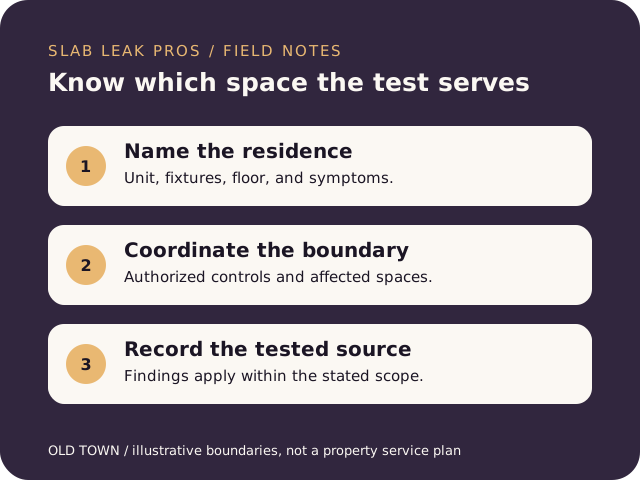
Start with the residence, its water connections, and any other occupancy affected by the proposed test.
Slab leak detection in Old Town Placentia, Placentia, CA investigates a hidden water loss before a repair location is chosen. It should identify the system tested and support any suspected pipe location. A building address alone may not describe all the spaces served by a control or meter.
The city describes Old Town as a mixed-use planning area, including opportunities for residences above other uses. That context does not mean every property has shared plumbing. It makes the actual occupancy and service boundary important when a residential inspection could affect another part of a building.
A wet upper room, a ground-level stain, and unexplained billed use may involve different systems. Describe the location and timing before assuming a buried residential supply failure. The inspector needs to distinguish the line serving the affected fixtures from nearby drain, fixture, or other water paths.
Our guide to professional slab leak detection explains the testing methods. In Old Town, ask how each result relates to the residence being assessed and what it can say about spaces outside that scope. A useful finding keeps those boundaries visible.
Which signs help define the source investigation?
A water-use timeline should account for relevant activity without assuming neighboring spaces were idle.
If you hear running water when your residential fixtures are off, note which controls or account you observed. Another served space may still have a legitimate demand. A no-use observation is meaningful only when the tested boundary and known uses are understood.
Report stains by floor and room, including any fixture above or beside them. Moisture can travel along building materials before becoming visible. A ceiling mark below a bathroom may need a different assessment from a continuously leaking pressurized line beneath a ground floor.
Warmth at a finished floor can help frame a hot-water investigation, but ordinary use and heating can also affect the surface. Keep the timing and fixture details. Thermal imaging shows surface temperatures and needs supporting evidence; it does not map every concealed pipe.
- Unexplained account use with the served spaces clearly identified.
- Persistent water sound during a documented quiet period.
- Repeated dampness at a ground-floor edge or interior wall.
- Changed fixture performance within the residence.
- Previous pipe changes or repairs across an occupancy boundary.
How should an Old Town detection appointment proceed?
Arrange the relevant occupants and authorized controls before changing water service.
- Define the residential scope. Identify the unit or dwelling, affected fixtures, and reported symptoms.
- Review the service connections. Establish the known reach of meters and controls without guessing from the address.
- Arrange affected access. Coordinate permission for any other space needed by the test.
- Assess and locate the loss. Use suitable branch tests and supporting acoustic or surface evidence.
- Record the limits. Distinguish confirmed findings from untested occupancy or concealed access.
Do not operate an unfamiliar control that may interrupt another residence or business. A property contact should help establish authority and an appropriate testing arrangement. The inspection should state if a missing control or unavailable space prevents a firm conclusion.
Listening evidence can narrow a pressurized loss after the relevant supply has been identified. Surrounding activity and sound transmission can complicate the reading. Ask how the result matches the branch test and why the proposed location is more than a noise heard through the building.
What changes the detection work in a mixed-use setting?
The relevant issue is the actual test boundary and access, rather than the planning-area label.
| Served occupancy | Which residence and other spaces, if any, are included by the tested controls? |
|---|---|
| Coordinated access | Who can authorize entry and any interruption affecting another occupancy? |
| Test conditions | How do ongoing demand, background activity, or unavailable spaces affect the result? |
| Additional steps | What authorizes a further test or opening after the initial assessment? |
Ask what the inspection price includes and which limits could require a revised scope. For covered plumbing repair, confirm requirements with Placentia Building and Safety using the actual occupancy and proposed work. Do not assume a residential permit path applies unchanged to every mixed-use property, or that testing approval authorizes finish removal elsewhere.
Which local facts help without assuming a uniform building?
Use the specific residence and utility account to complete the work information.
| County | Orange County, California. |
|---|---|
| Plumbing permits | Placentia Building and Safety; confirm the requirements for the actual occupancy and covered work. |
| Water supplier | Check the current service account or verified utility address information. |
| ZIP | 92870 is supported by local records; confirm the full residence or unit address. |
| Building context | Mixed-use city planning area with residential uses, including upstairs residences. No uniform house age, foundation, or service arrangement is assumed. |
What should you ask and check after the inspection?
The report should remain understandable to anyone arranging the authorized repair later.
Ask which evidence would confirm the suspected system and whether the test depends on another occupancy being quiet or accessible. Agree on what happens if that condition cannot be met. A limited inspection can still be useful when its limits are stated clearly.
After testing, retain the branch description, served fixtures, location references, and any unassessed areas. Confirm which controls were operated and how service was left for every affected space. Check that temporary restrictions are communicated to the responsible occupants.
If a supported failure is accessible locally, review spot repair in Old Town Placentia for the opening and finish scope. If the source instead involves drainage, the Old Town under-slab drain guide explains why that system needs its own assessment. Do not use a supply test to declare an unrelated drain sound.
The Old Town repair overview organizes the other methods. We also explain the decision in our Placentia guide to defining a hidden-leak repair scope, with source findings, authorized access, verification, and remaining restoration kept together.
Slab Leak Detection questions in Old Town Placentia
Old Town answers clarify mixed-use assumptions, upstairs moisture, ongoing demand, and sharing the inspection record.
Does every Old Town residence share a meter with another use?
No. The mixed-use planning context does not establish the connections at a particular property. Verify the actual account, controls, and tested supply before interpreting a reading or arranging a shutoff.
Can an upstairs residence have a slab leak symptom?
It can have moisture that needs investigation, but floor level alone does not identify the source. In Old Town, describe the affected room and nearby fixtures so testing can distinguish supply, fixture, and drain paths.
What if another occupancy stays active during testing?
Ask how that activity affects the proposed test and whether a different boundary or coordinated time is needed. Known use outside the residence can limit a wider meter observation. The report should state the conditions under which the result was obtained.
Who should receive the final detection record?
Keep a copy with the person authorized to approve the repair, and communicate relevant restrictions to affected occupants. The Old Town record should name the inspected residence and test limits so later work does not assume broader access or findings.